
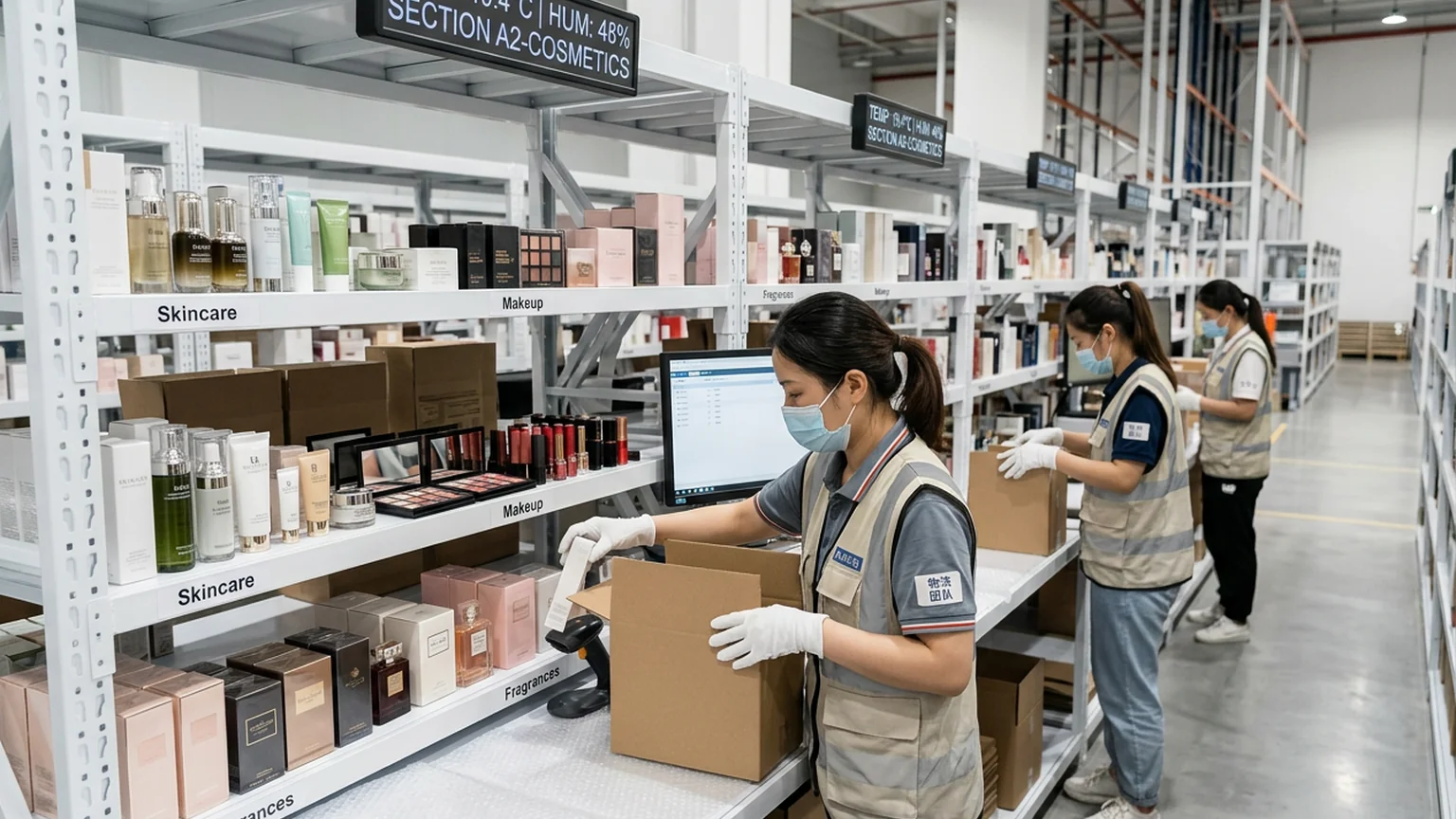
Cosmetics, skincare, fragrance and personal-care items fail in two ways that apparel and hardware do not. They degrade while nobody is looking, and they expire while still in stock. A heat wave in a container yard can separate an emulsion that passed inspection three weeks earlier. A lot that sells easily in March becomes unsellable inventory in November.
Fulfillment for beauty categories is therefore a dating and storage-discipline problem first, and a picking-and-packing problem second. The brand keeps regulatory responsibility; the warehouse keeps the physical conditions, the lot records and the packing standard honest.
Start from what the product label already tells you
Every cosmetic already carries handling instructions from its own compliance work: storage directions, a PAO (period after opening) symbol, a batch or lot number, and an ingredient list. Those printed constraints are the operating specification for the warehouse. Where a formulation is heat-sensitive, light-sensitive or prone to crystallisation, the storage requirement belongs in the written scope for that SKU rather than in a general instruction to store carefully.
What a fulfillment partner should be able to describe is how it meets those requirements in practice: which racking areas sit away from rooflines and dock doors, where temperature and humidity readings are taken and how often, how deliveries arriving hot are handled before they are put away, and what happens when a reading goes out of range. Ask for that level of detail per site. Our warehouses in Shenzhen, Suzhou and Dongguan carry different building characteristics, so the answer differs by location.
Lot control is what makes expiry workable
A warehouse that receives beauty stock by SKU alone cannot manage expiry. It has to receive by SKU and lot, record the manufacture and expiry dates at the receiving bench, and keep those dates attached to the units through put-away, picking and shipping.
From there the picking rule changes from first-in-first-out to first-expiry-first-out. FEFO sounds obvious and fails in practice for three reasons: lots get mixed in a shared bin, a fast-moving SKU is replenished with newer stock placed in front of older stock, and returned units re-enter inventory without their dates being re-read. Each of those is a process control, not a software feature.
Brands should set two thresholds in advance. The first is a receiving gate: no stock accepted with less than an agreed share of shelf life remaining. The second is a flagging rule: which lots get reported as approaching the brand's own sell-by cut-off, so the brand can decide between a promotion, a channel change, or removal. That decision is commercial and stays with the seller.
| Control point | What the warehouse records | What the brand decides |
|---|---|---|
| Receiving | Lot code, manufacture date, expiry date, arriving condition of seals and cartons | Minimum acceptable remaining shelf life |
| Storage | Location of each lot, temperature and humidity readings, out-of-range events | Whether an affected lot is quarantined or released |
| Picking | Which lot left the shelf for which order | FEFO cut-off and allocation priority between channels |
| Approaching expiry | A dated exception list, not a verbal warning | Discount, channel switch, hold, or disposal |
| Returns | Whether the returned unit's dates are still legible and valid | Restock, destroy, or route for local disposition |
Documentation and market rules travel with the product
The obligations that sit behind beauty products change by destination, and the warehouse's role is verification rather than certification. In the United States, the Modernization of Cosmetics Regulation Act introduced facility registration, product listing, safety substantiation and adverse-event recordkeeping duties for cosmetic manufacturers and distributors. In the European Union, cosmetics require a Responsible Person and notification through the CPNP portal before the product is placed on the market, with an ingredient labeling format that the UK now runs separately under its own cosmetics regulation.
None of that is established by a fulfillment center, and a provider that claims to handle it on your behalf should be questioned. The useful scope is narrower and still valuable: checking that the required marks, labels and documents exist and are legible before units leave the building, holding stock that fails the check, and escalating to the brand instead of shipping and hoping. The same principle applies across regulated categories, which is why the compliance verification roles are mapped out separately in our product compliance guide for China exports.
Labeling detail is where brands get caught. An ingredient list in the wrong language, a missing Responsible Person address, a country-of-origin mark that does not match the declaration, or a sample sachet included in a parcel destined for a market that restricts unlabeled samples can all stop a shipment that was otherwise perfect.
Fragile, liquid and temperature-exposed packing
Glass bottles, pressed powders, ceramic applicators and dropper assemblies break in specific and repeatable ways. Leaking is worse than breaking, because one failed bottle can ruin a carton of otherwise sellable units and the parcels around it.
A workable packing standard for beauty is written per product family and proven on a physical example before launch: inner protection that stops caps from loosening, secondary containment for liquids, cushioning that survives a drop rather than only a shelf, and a box that keeps its structure under the weight of the contents. Unboxing presentation matters in this category more than most, so the branded materials and the protection requirements have to be reconciled in the same specification rather than negotiated at the packing bench.
Heat adds a further constraint on the outbound leg. Summer departures and warm destination climates are not the same risk as winter stock movement, and the mitigation is chosen per lane and season: insulated inner packaging, gel packs sized to the transit profile, or simply moving a heat-sensitive SKU to a different channel at a particular time of year.
Questions worth asking before you commit inventory
A provider that handles beauty well answers these concretely: which storage areas are used and how they are monitored, how lots are captured at receiving and enforced at picking, what the exception report looks like when dates approach, who decides on quarantine after a temperature excursion, and exactly what gets verified against destination requirements before a parcel is released. Vague reassurance about premium handling is the signal to keep looking.
Frequently asked questions
What storage conditions does cosmetics fulfillment require?
Start from the product's own labeling and formulation limits rather than a generic range. Ask the warehouse which areas are used, where readings are taken, how often they are logged, and what happens when a reading falls outside the agreed band. Heat- or cold-sensitive formulations need a written per-SKU requirement.
How are expiry dates controlled in a shared warehouse?
By receiving and storing on lot level with manufacture and expiry dates, then picking first-expiry-first-out. The common failure points are mixed lots in one bin, newer stock placed in front of older stock, and returns re-entering without dates being re-read.
Does the fulfillment provider handle FDA or EU cosmetics compliance?
No. Registration, safety substantiation, Responsible Person duties and product notification sit with the brand, manufacturer or importer. A warehouse can verify that required marks, labels and documents are present and legible, hold stock that fails, and escalate rather than ship.
How do you ship glass bottles and pressed powders?
With a packing standard written per product family and proven on an approved physical example before launch: cap protection, secondary containment for liquids, cushioning tested against drops, and a carton that holds its shape. Presentation requirements are resolved in the same specification.
What happens to stock that is close to expiring?
It should appear on a dated exception list rather than being mentioned verbally. The brand then decides between promotion, moving the lot to another channel, holding it, or disposal. The warehouse supplies the data and executes the decision.
Quellen und Überprüfungslinks
Operative Regeln können sich ändern. Prüfen Sie die verlinkten Primärquellen und bestätigen Sie sendungsspezifische Anforderungen vor der Buchung.
- FDA — MoCRA cosmetics regulationOffizielle Quelle
- EU cosmetics regulationOffizielle Quelle
- FDA — Regulated productsOffizielle Quelle
- CBP — Importing guidanceOffizielle Quelle