
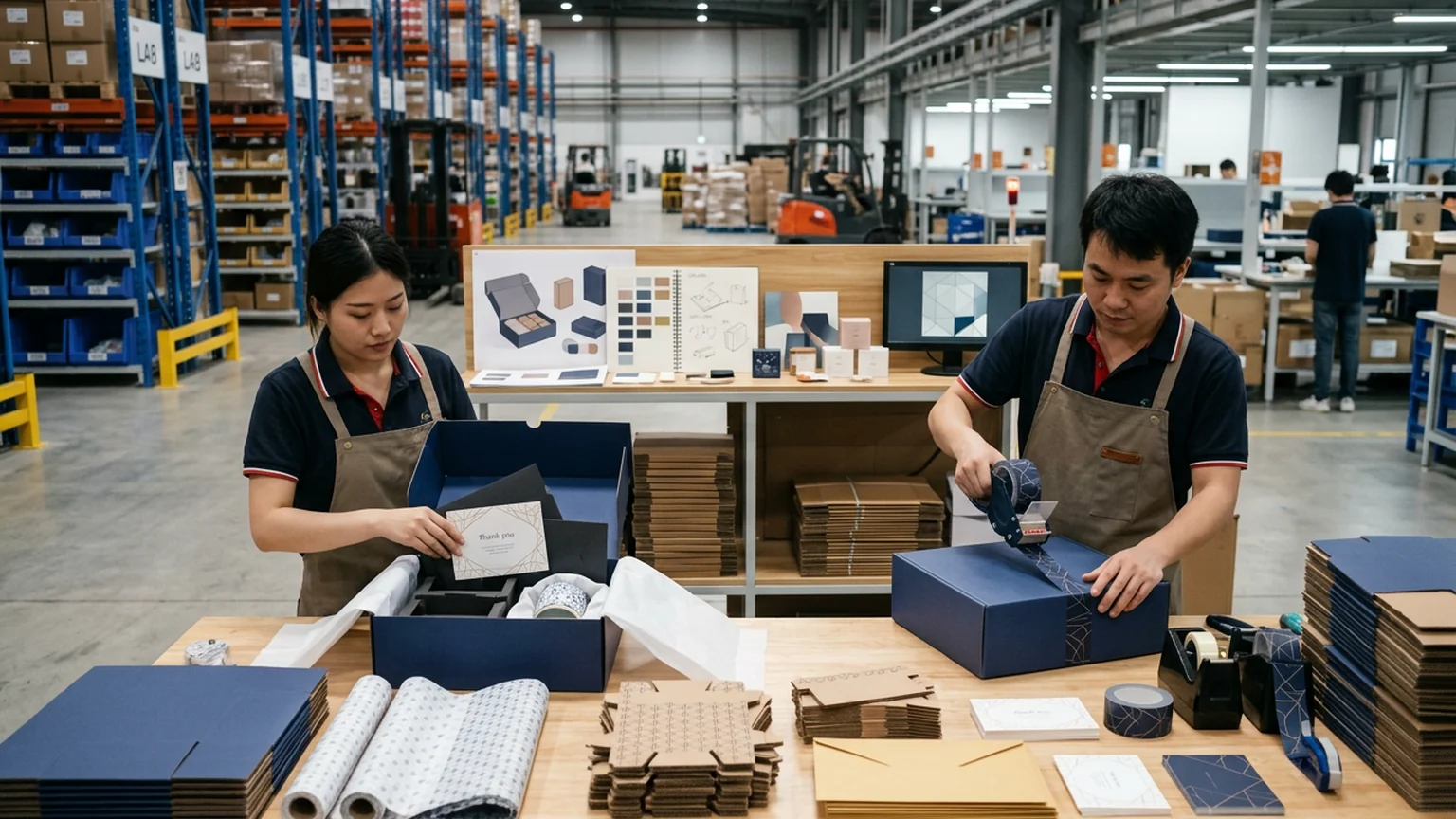
Branded packaging is the part of a China fulfillment program that sellers approve with the most enthusiasm and revisit the least. The box gets designed, the sample photos look right, and then nobody touches the specification again until damage claims, stockouts or a dimensional-weight bill force the conversation.
Treated properly, packaging is three decisions made once and audited periodically: what protects the product, what the packing bench can actually reproduce at volume, and what the combination costs per order once materials, labor and shipped volume are counted together.
Write the approved pack example before ordering print
The reference document is a physical example, assembled at the bench, with the actual product inside, photographed and signed off. Everything else is a description that has to be interpreted. A usable example records the box or mailer and its board grade, the inner protection and how it is folded, where the product sits and in which orientation, how multiplicables are separated, which insert goes in and in what order, where the seal runs, and exactly where the shipping label and any compliance marks are placed so they are neither obscured nor applied over required text.
Version control matters more than brands expect. When the tissue supplier changes weight, the insert gains a QR code, or a product gets a new mold, the example has to be re-approved. Otherwise the warehouse keeps packing to a standard that no longer describes anything real, and every inconsistency becomes an argument.
| If you change | Re-approve | Because |
|---|---|---|
| Board grade, wall or supplier | Pack example and drop behavior | Protection and crush resistance move with board specification |
| Box or mailer dimensions | Dimensional-weight profile and pallet/carton stack | Shipped volume and freight cost follow the outside dimensions |
| Insert set or print file | Pick-and-pack instruction and material location | Pickers need to know which insert belongs to which order type |
| Product variant or packaging shape | Product-to-pack matrix | The previous protection logic may no longer apply |
| Destination marketplace or channel | Labeling and prep requirements | Market-specific labels cannot be hidden or overlapped |
Materials are inventory, not a one-off purchase
Custom packaging behaves like any other stock line: it has a lead time, a minimum order quantity, a storage requirement, a consumption rate and a failure mode when it runs out mid-season. Print runs are typically committed in bulk, which means the material has to be stored somewhere clean and dry for months, with the older print version retired rather than mixed into active use.
Decide who buys it. Brands often ship materials in from their own supplier; a warehouse can also source against a specification, which saves the inbound freight but transfers quality risk to a party that sees only a sample. Whichever route you choose, record the specification in measurable terms rather than adjectives. Paper weight, board grade, flute profile, ink and finish, tolerance on dimensions, and the acceptable color reference all survive a supplier change; "premium matte feel" does not.
Then set the reorder logic against the consumption rate the warehouse can report: a minimum on-hand level expressed in weeks of peak volume rather than average volume, because the shortage always happens in the month you cannot reorder in time.
Structure and cost move together
Packaging cost per order has four components: the material itself, the labor to assemble and fill it, the consumables around it, and the freight consequence of the volume you chose to ship. The last one is the least visible. A taller box that feels generous protects the product well and can cost more than the item inside it across a year of parcels, because carriers bill on dimensional weight when the volumetric figure exceeds actual weight.
The productive exercise is a product-to-pack matrix: for each SKU or size band, the smallest carton or mailer that reliably delivers the product undamaged, with the resulting dimensional weight recorded. Most catalogs carry a small number of size bands and end up needing a handful of pack formats. Right-sizing is usually worth more than negotiating the print price, and it also reduces the void fill that has to be added to stop contents shifting.
For bulky or heavy items, the decision changes character. Double-wall board, corner protection and a heavier carton may raise material cost while lowering damage and claim cost, and the arithmetic only works when both sides are counted. That trade-off is described in practical terms in our home and garden fulfillment guide.
Compliance sits underneath the branding
Two regulatory realities interrupt packaging plans regularly. Wood packaging material used for shipping, including pallets and dunnage, is subject to ISPM 15 treatment and marking for international movement; printed consumer packaging is generally not, but the distinction is worth confirming for any component that is genuinely wood. Marketplaces impose their own prep and labeling rules, and a branded box is acceptable only where it does not conflict with the required barcode placement or the marketplace's packaging requirements.
Environmental claims deserve the same discipline as print specs. A recyclability statement has to be true in the destination market, where collection infrastructure differs by region, and a claim that cannot be substantiated invites both platform and advertising scrutiny. Where a marketing team wants to say something is recycled, recyclable or compostable, the material specification should support it in writing.
Design also has to stay out of the way of required information: country-of-origin marking, safety warnings, fibre-content declarations and any marketplace label must remain legible after the box is sealed and labeled. The cheapest fix is usually a print layout change, not a bench workaround.
Pilot the format before you commit the print run
The reliable sequence is short. Build the pack with a real product inside. Drop it, in a controlled way, and stack it. Have someone who was not present at the design approve it as reproducible by an ordinary packer on an ordinary shift. Then run a limited wave, count damage and labor minutes, and only then place the bulk print order. Brands that reverse this order learn the lesson through a pallet of obsolete cartons.
Frequently asked questions
What does custom packaging add to cost per order?
Four things rather than one: the material, the assembly and packing labor, the consumables it displaces or requires, and the freight consequence of the volume you now ship. The last is usually the largest and is the first to be forgotten, because it appears on a carrier invoice instead of a packaging invoice.
Who supplies the packaging materials?
Either route works. Brands ship stock in and keep control of print quality and cost; a warehouse sources against a written specification and saves inbound freight. What matters is that the specification is measurable and that someone owns the version that is currently in use.
How is packing consistency enforced?
Through an approved physical pack example that records materials, folding, orientation, insert order, sealing and label placement, plus a re-approval rule whenever any input changes. Bench interpretation is what creates variation.
Does dimensional weight really change packaging design?
Yes. Right-sizing a carton to the product often saves more than negotiating print pricing, because carriers bill volumetric weight when it exceeds actual weight. A product-to-pack matrix is the practical way to find those savings.
Can packaging carry sustainability claims?
Only claims you can substantiate for the destination market, where collection and recycling infrastructure differ. Material specifications should support the wording, and required markings such as origin and safety information must stay legible after the pack is closed.
Quellen und Überprüfungslinks
Operative Regeln können sich ändern. Prüfen Sie die verlinkten Primärquellen und bestätigen Sie sendungsspezifische Anforderungen vor der Buchung.
- Ecommerce packaging trendsOffizielle Quelle
- Sustainable packaging guideOffizielle Quelle
- IPPC — ISPM 15 implementationOffizielle Quelle
- Amazon — Packaging, preparation and labelingOffizielle Quelle