
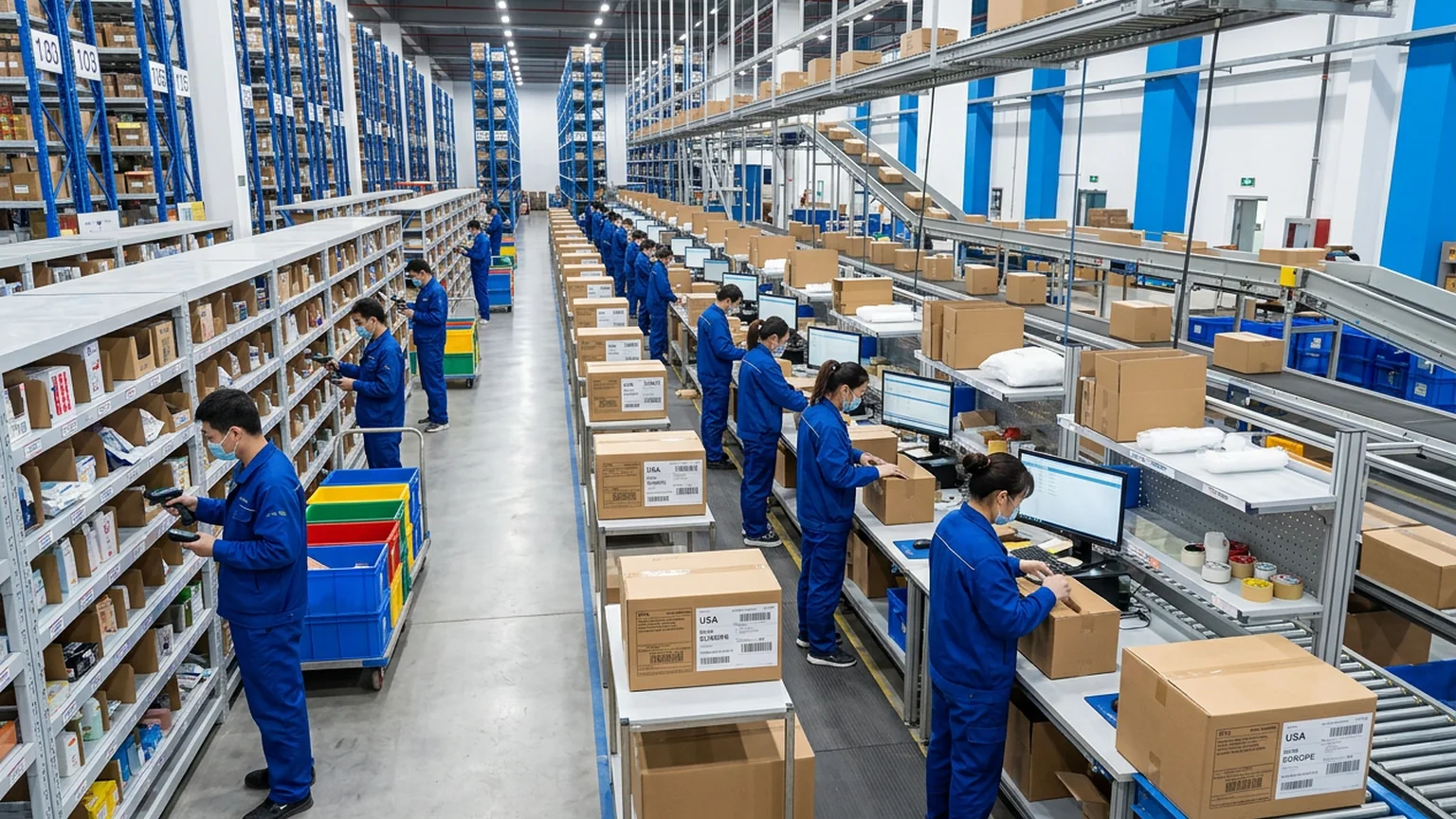
A direct-to-consumer brand fulfilling from China is running a slightly unusual business shape: the storefront is local, the customer is overseas, and the inventory sits next to the factory. That arrangement is genuinely efficient for a catalog that is still finding out what sells, and genuinely fragile once volume matters, because every order crosses a border and every delay becomes a support ticket.
The model is worth choosing deliberately rather than by default. The variable that decides whether it works is not warehouse quality. It is how much of the operation the brand has written down.
Where the inventory sits decides your cash position
Holding stock in China means replenishment is short and cheap, because the goods are close to where they are made. Restocking a sold-out variant is a domestic move, not an ocean booking. That is the structural advantage over an overseas 3PL, and it is why DTC brands with wide catalogs or fast product cycles keep their China-based operation even after they open a US storage arrangement.
The cost of the same structure shows up in the customer's experience: every order leaves the country of origin, so every order carries customs data, a tax treatment decision and an international transit. Brands that mix models usually end up positioning proven sellers offshore and keeping long-tail and test inventory in China. That split is a rational response, and it needs a rule for which SKUs live where, when they migrate, and what happens when the offshore pool runs dry mid-campaign.
The order record is the only authoritative input
Everything downstream depends on the order file. The warehouse needs a line item that resolves to a physical unit, a quantity, a delivery address that will pass carrier validation, a contact that the destination carrier can use, and any packing instruction that makes this order different. What it must not do is infer the missing pieces from a product name, a previous order, or a reasonable guess.
That is also where most first-month incidents live. Two variants that differ only in a suffix the store strips, a bundle that maps to components in one system and a single SKU in the other, a cancellation that arrives after the pick wave, and an address with the apartment number in a field the connector drops. Each of these is caught by a short test plan walked through end to end before the first real order, and each is expensive to catch in production.
Choose the lane per order, not per relationship
Brands regularly commit to one channel and then discover that it is wrong for half their destinations. A lightweight accessory to a US east-coast postcode, a bundled set to Germany, and a heavy single item to a Canadian prairie town are three different economic problems.
The comparison fields are stable: packed weight and dimensions, product characteristics that restrict channels, destination and postcode band, the tracking depth the customer will be told about, the tax treatment already settled at checkout, and the total quoted cost with its start point defined. A quote measured from warehouse release is not comparable with one measured from carrier acceptance. If a lane looks dramatically cheaper than the alternatives, the difference is usually in that start point or in the delivery scope rather than in the transport.
| Decision | Warehouse owns | Brand owns |
|---|---|---|
| Stock position | Receiving, put-away, cycle counts, discrepancy reporting | Which SKUs sit in China, which move offshore, when |
| Order release | Validation, exception flags, pick wave, packing, handover | Data quality, mapping rules, cancellation cut-off |
| Channel choice | Presenting eligible lanes with quoted totals | Selecting the lane and accepting the service trade-off |
| Brand experience | Executing the approved pack example, material stock levels | Design, inserts, replenishment thresholds, version changes |
| Compliance | Verifying marks and documents are present and legible | Product registration, classification, declared value, tax scheme |
| Exceptions and returns | Inspection, photographs, quarantine, disposition execution | Refund, replacement, marketplace response, disposal thresholds |
Brand experience is a specification, not an intention
Custom boxes, tissue, cards, samples and bundles are all workable, and all of them fail in the same way: the approved example is treated as a reference photo rather than a standard. The version that gets executed needs to record materials, folding, orientation, insert sequence, sealing and label placement, and it needs a re-approval trigger whenever any input changes. Material stock levels belong in the same agreement, with a reorder point expressed in weeks of peak rather than average volume, because the shortage always lands in the month you cannot replenish.
Compliant information has to survive the branding. Origin marking, safety warnings and marketplace labels stay legible and unobstructed after the parcel is closed. A branded box never substitutes for a correct customs declaration.
Decide returns ownership before the first one arrives
Cross-border returns are the most common source of friction between brands and their fulfillment partner, because both sides assume the other is handling the customer. Set out the return address by destination market, the authorization route, the inspection criteria, and the value threshold under which local disposition is cheaper than re-export. Then separate the physical from the commercial: the warehouse inspects, photographs, quarantines and executes; the brand refunds, replaces, answers the marketplace and decides whether a unit is restocked. A provider that quietly restocks returned units without a written rule is creating a quality problem you will discover through reviews.
Brands comparing a China-based operation against a domestic warehouse usually find that the deciding factor is not cost per order but how much of the exception path they are willing to run themselves, which is exactly the trade-off examined in China fulfillment versus a US warehouse.
Frequently asked questions
Can one China warehouse run a whole DTC operation?
It can run the physical side: receiving, storage, picking, packing, carrier handover, exception handling and returns inspection. The storefront, pricing, customer data, product compliance and all commercial decisions remain with the brand. Any provider claiming otherwise is describing a different service.
Which SKUs should stay in China and which go offshore?
Position proven, fast-moving lines where domestic delivery economics win, and keep long-tail, test and fast-cycling inventory close to the factory where replenishment is cheap. Write the migration trigger and the fallback rule before you need either.
What makes a China-origin DTC order fail most often?
Order data. Variant mappings that collide, bundles that resolve differently in each system, cancellations arriving after the pick wave, and address fields dropped by a connector. All of them are found in a short end-to-end test before launch.
Who handles international returns?
Agree the shape first: return address by destination, authorization route, inspection criteria and a disposal threshold. The warehouse inspects and executes; refunds, replacements and marketplace responses stay with the brand unless separately agreed.
Does branded packaging complicate customs?
It should not, provided required markings stay present and legible and the declaration reflects what is in the box. Problems start when inserts add value that is not declared, or when labels are applied over origin or safety information.
Quellen und Überprüfungslinks
Operative Regeln können sich ändern. Prüfen Sie die verlinkten Primärquellen und bestätigen Sie sendungsspezifische Anforderungen vor der Buchung.
- Shopify — FulfillmentOffizielle Quelle
- Shopify — International shippingOffizielle Quelle
- CBP — Importing guidanceOffizielle Quelle
- Amazon — Ecommerce fulfillmentOffizielle Quelle