
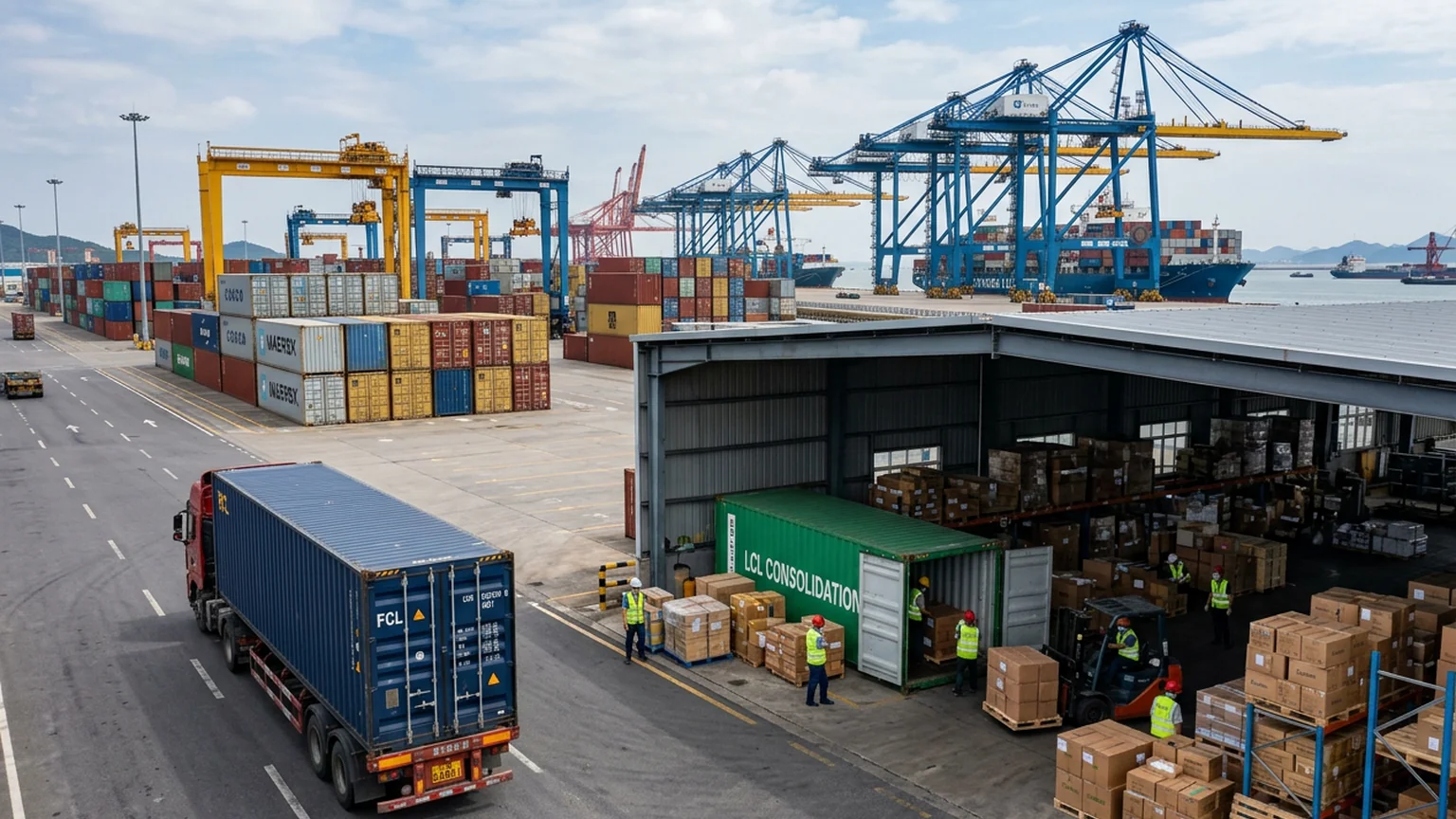
Most sellers decide LCL or FCL by looking at a rate sheet and dividing. That comparison is wrong more often than it is right, because groupage pricing carries charges that a per-cubic-meter rate hides, and a full container carries fixed costs that a volume forecast hides.
The correct question is not which rate is lower. It is which mode's cost structure fits the cargo you actually have.
How each option is really charged
A full container is a fixed price for a box plus a set of origin and destination charges that do not shrink when you underfill it. You pay for the container whether it holds four cubic meters or fifty. You control the stuffing schedule, the sealing, and the condition of the box.
Groupage is sold per cubic meter or per revenue ton, whichever is greater, with a minimum charge that commonly starts around one cubic meter. On top of the freight rate sit origin handling at the container freight station, destination deconsolidation and storage, delivery-order and notice fees, and often a per-shipment minimum on those local charges. Those add-ons are per shipment, not per cubic meter, so a small shipment pays them disproportionately. This is why a quotable "rate per cubic meter" is not comparable to an FCL rate without the local charges included.
That difference produces the break-even shape: groupage can be genuinely cheaper for a handful of cubic meters, becomes expensive in the mid-range once local charges and minimums are added, and stops making sense entirely when your volume is close to filling a box.
| Decision factor | Groupage (LCL) | Full container (FCL) |
|---|---|---|
| Cost driver | Per cubic meter or revenue ton, plus fixed per-shipment local charges | Fixed container rate plus terminal and haulage charges |
| Practical volume range | A few cubic meters up to well under a box | Anything approaching a usable container volume |
| Transit time | Slower: consolidation wait, then deconsolidation before release | Faster: straight to the port once stuffed |
| Schedule exposure | Dependent on the consolidator's sailing and cargo mix | You book the box and the sailing |
| Cargo risk | Handled repeatedly between CFSs, more touch points | Sealed from origin stuffing to destination devanning |
| Packing requirement | Must survive shared handling and stacking; palletize where possible | Can be engineered to the specific load |
| Documentation | House bill plus master bill, consignee coordination | Single carrier bill, simpler parties |
| Weight considerations | Dense cargo is charged on weight over volume | Payload limit per container size and type |
| Control over condition | Low: your goods travel with other people's | High: you choose dunnage, bracing and sealing |
Container sizes, and usable volume
A 20-foot general-purpose box has a nominal cube around 33 cubic meters and a payload limit that is often the binding constraint for dense cargo such as tile, hardware, cast iron and liquids. A 40-foot general-purpose box is nominally around 67 cubic meters with a lower payload-to-volume ratio, and a 40-foot high-cube adds roughly ten to twelve cubic meters of height volume without adding payload. Door height and door width matter for awkward single pieces.
Realistic usable volume is materially below nominal: cube is achieved only with regular cartons, good stacking and deliberate load planning, and it disappears completely with irregular items. Anyone quoting you a "capacity" without seeing your carton dimensions is guessing. A practical load plan is carton footprint by height by number of tiers, checked against door clearance and against the weight limit, with the heavy items low.
The packing standard is not the same
Groupage demands more from your packaging than a full container does. Your cartons will be lifted, stacked and possibly re-handaled at two container freight stations, and they may sit outdoors briefly. palletized, shrink-wrapped and banded and strapped loads with corner protection survive that journey far better than loose cartons, and palletising also makes the volume measurement predictable rather than negotiated.
Solid wood packaging used for pallets and crates in international trade needs heat treatment and the visible ISPM 15 mark, so specify treated pallets or switch to plastic or plywood pallets. Loose, unbanded cartons can also attract repacking or restuffing charges at destination. Packing against the CTU Code loading principles is the reference standard most of these rules trace back to.
Charges that appear after the rate is agreed
Five categories cause most of the regret on an FCL booking.
Demurrage and detention. Free time at the destination is finite. If the consignee cannot devan fast enough, container storage and equipment charges accumulate daily, and they can exceed the freight saving that motivated the booking.
Peak season and general rate increases. Spot rates on both groupage and FCL move sharply around the third and fourth quarters. A rate valid this month is not a cost basis for a quarterly plan.
Rolled cargo. When a service overbooks, containers get rolled to the next sailing. Groupage is also exposed when the consolidator's cargo does not fill the box.
VGM and declared weight. Ocean containers require a verified gross mass before loading, obtained by weighing the packed box or by a certified calculation method. Incorrect declarations delay or block the shipment.
Terminal and surcharge lines. Bunker, currency and terminal handling charges move independently of the base rate and are where a cheap all-in quote sometimes stops being cheap.
A decision method that survives contact with a quote sheet
Take the same cargo and price both options landed at the destination door, including origin handling, documentation, destination deconsolidation or devanning, duties, haulage, an allowance for expected damage, and the cost of the extra transit days in your cash cycle and your delivery promise. Then add the operational dimension: how much rehandling your product can take, whether your cartons are regular, whether a single consignee can receive and empty a container quickly, and how much schedule certainty your customers actually need.
In practice this produces three bands. Very small volumes go groupage without debate. Volumes approaching a container go FCL without debate. The middle band, which is where most growth-stage sellers sit, is decided by the destination charges and the rehandling risk, not by the freight rate. If your goods are fragile, mixed, or repeatedly urgent, it is often cheaper to ship a part-filled container than to fill a box and pay for the damage. For the lane-level comparison, see our guide to hybrid sea-air shipping from China.
Frequently asked questions
At what volume does a full container become cheaper than groupage?
There is no fixed cubic-meter figure, because groupage local charges are per shipment while container rates are fixed. Price both landed at the door for the same cargo. The crossover usually moves upward as the shipment gets smaller, because minimum charges dominate.
Is groupage riskier for my goods?
Generally yes, because the cargo is handled at a container freight station at each end rather than traveling sealed. Palletising with ISPM 15 treated or non-timber pallets, bandestrapping and corner protection close most of the gap.
What is a revenue ton?
The greater of the shipment's weight tonnage or its cubic measurement, used as the chargeable basis for groupage and many other freight products. Dense cargo is charged on weight; light bulky cargo on volume.
What charges appear after booking?
Destination demurrage and detention when free time is exceeded, terminal handling and bunker or currency adjustments, repacking or restuffing at a container freight station, and verified gross mass corrections. Ask for the destination tariff before committing.
Can I mix suppliers in one container?
Yes, and this is one of the strongest arguments for a destination consolidation warehouse. Multiple factory deliveries can be received, checked, and then stuffed as one shipment, which turns several small groupage moves into a single container booking. Our multi-factory consolidation guide covers the mechanics.
Quellen und Überprüfungslinks
Operative Regeln können sich ändern. Prüfen Sie die verlinkten Primärquellen und bestätigen Sie sendungsspezifische Anforderungen vor der Buchung.
- Freightos — LCL vs FCLOffizielle Quelle
- Maersk — Container shippingOffizielle Quelle
- UNECE — CTU Code (cargo transport unit packing)Offizielle Quelle
- International Trade Administration — Shipping and logisticsOffizielle Quelle