
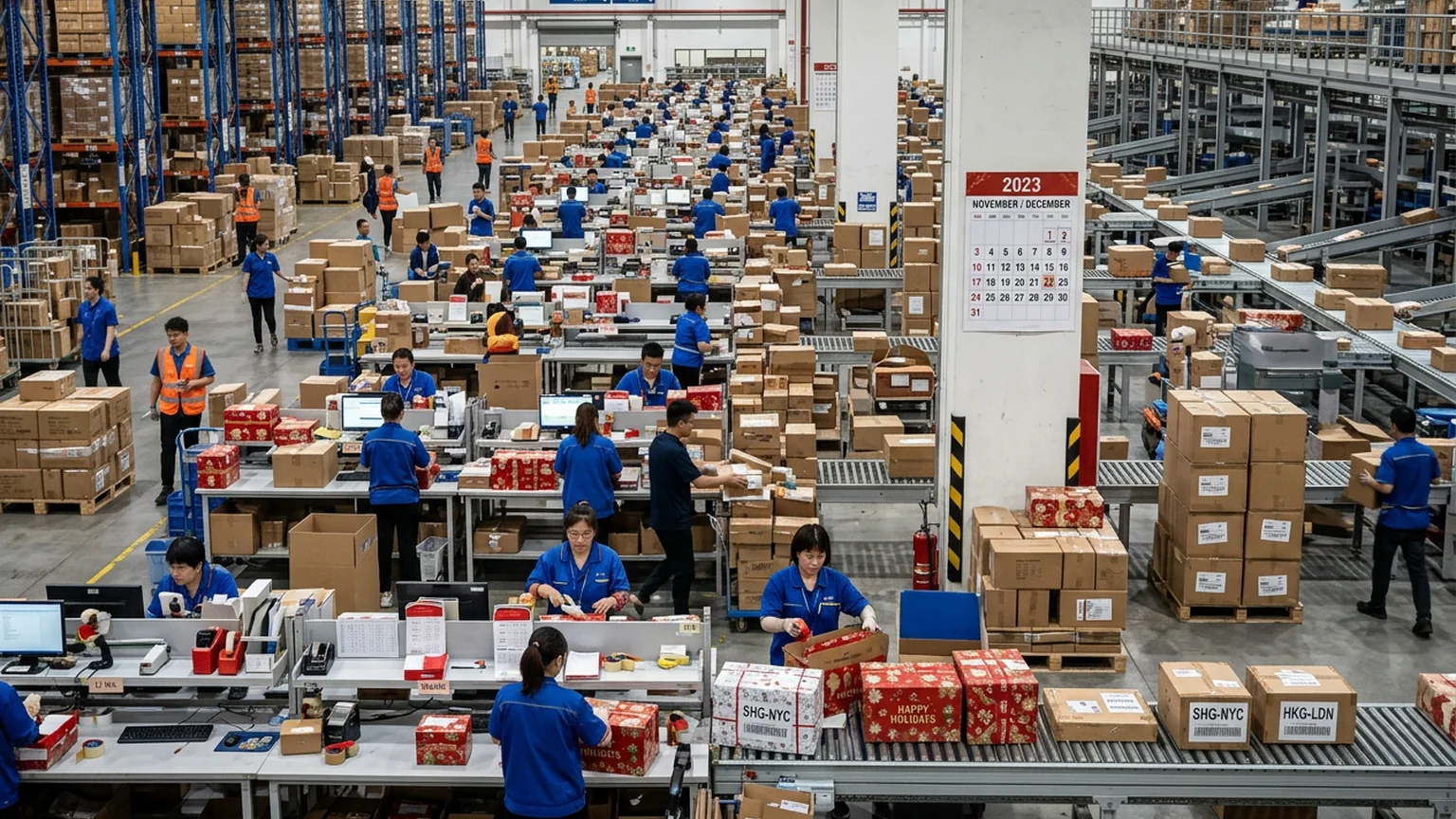
Peak season is not one busy month. It is a window in which ocean capacity, air capacity, courier sorting, port labor, customs staffing and your own warehouse hours are all simultaneously tighter and more expensive, while your customers' tolerance for delay is at its lowest. Sellers plan for the demand and are defeated by the supply side.
The work that pays is deciding, before September, which orders you will accept, which lanes you will rely on, and which promises you will stop making.
Start from the calendar, not the forecast
Q4 has a fixed structure. US Thanksgiving falls on the fourth Thursday of November, and the retail surge around it runs through December. European markets compress into the same fortnight. Chinese manufacturing and logistics slow for the National Day holiday around the start of October, and the Lunar New Year shutdown in January or February cuts off replenishment again immediately after the peak. That second closure is the one sellers repeatedly forget: the container you cannot fill in February was supposed to be on the water in December.
The planning output is a cutoff calendar, not a target number. For each lane you intend to use, record the last date an order can be tendered and still have a reasonable chance of a stated delivery date, the carrier's own published peak deadlines where they exist, and the date your warehouse stops accepting non-critical inbound stock. Then work backwards from each cutoff by the lane's slow-season transit plus a buffer, and you have the real order deadlines, which are earlier than the carrier's.
| Peak season pressure point | What tightens | Plan to decide before September |
|---|---|---|
| Ocean capacity | Allocated space, rolled cargo, equipment availability | Book allocations early; accept a higher rate over a roll |
| Air capacity | Blocked-space rates and cut-offs for e-commerce air | How much air volume you will buy in advance |
| Courier and parcel | Sorting capacity, surcharge bands, size limits | Which lanes you will pull when one degrades |
| Port and customs | Examination queues, broker processing times | Whether your importer-of-record setup can scale |
| Chinese labor | Overtime, turnover, holiday shutdown | Packing hours available per day, and a ceiling |
| Your inventory | Lead time variance, supplier delays | Which SKUs get pre-positioned and which get cut |
| Marketplace inbound | Appointment slots and fulfillment center cutoffs | Latest receipt date per destination center |
| Customer expectations | Delivery promises and refund demands | What your product page actually claims |
Capacity is bought, not found
Freight capacity in peak season is allocated in advance. Carriers sell blocked space, and the space that appears on the spot market in November is the space that was not sold, at the price that reflects that. The practical response is to buy a committed volume you are confident to use, keep a spot allocation for upside, and accept that paying slightly more for a reliable booking is cheaper than a rolled container in the week you most needed it.
Ask your forwarder three specific questions in August: what allocation can you hold for the weeks either side of the peak, what is your policy when cargo rolls, and what notice do you give before a surcharge takes effect. The quality of those answers tells you more than the rate does.
Position inventory, but only the right inventory
Pre-positioning stock in a destination warehouse is the single most effective peak-season intervention, because it removes the international leg from the order-fulfillment path. It is also the most expensive mistake when applied to the wrong SKU.
The correct filter is not bestseller status. It is a combination of predictable velocity, healthy contribution margin per cubic meter of storage, low variant complexity, low return rate, and a plausible tail after the peak. A size- and color-matrixed apparel item with a high return rate is a poor candidate even when it sells well, because you are stocking the returns as well as the sales. A consumable or accessory with steady year-round demand is a better candidate even though it is less exciting.
Split your range explicitly: what you will commit to overseas stocking, what will ship direct from China within the cutoff window, and what you will deliberately stop advertising once the cutoff passes. The third category is what protects your rating.
Lanes, and the discipline of a second one
Every lane you use in peak season should have a named fallback and a pre-agreed trigger for switching, because the time to decide is not the week the primary lane is failing. Typical triggers: sustained scan-to-delivery time above your promised window, a sorting backlog disclosed by the carrier, a surcharge that crosses your margin, or a customs examination rate that starts to look structural rather than random.
Parcel direct from China remains attractive in peak season for low-value, low-weight, non-urgent orders, and falls apart for anything time-critical once lanes saturate. Courier networks hold up better under pressure and cost more. Sea freight plus destination warehousing is the volume answer, provided the inventory landed in time. Some sellers route by destination region and product value rather than by product type, which tends to be more robust than a single global rule. Our guide to air small-parcel shipping from China sets out how the direct parcel lane behaves under load.
Inside the warehouse
Peak-season failures are frequently internal. Three things decide whether a China fulfillment operation holds: labor, consumables and exception handling.
labor means overtime capacity, a trained temporary workforce that does not destroy your packing standard, and QA that survives the volume. Ask your fulfillment partner for last year's peak throughput figures against this year's expected daily order count, not annual averages.
Consumables means cartons in the sizes you actually use, void fill, labels, thermal printers and spare print heads. Carton shortages in December are entirely avoidable and happen every year.
Exception handling means a defined path for a failed address, a stockout discovered at pick, a prohibited content flag, a customs hold, and an order that can no longer make the promised date. The worst operations resolve these by sleeping on them. The good ones have a written rule and a queue with an owner.
Communicate the promise you can keep
Product pages and checkout messages are the cheapest peak-season defense. A realistic delivery window that is met beats an optimistic one that is not: the same delay produces a refund request when the customer was lied to and a patient wait when they were told. Set cutoff dates visibly, adjust the displayed estimate as the window closes, and stop advertising the SKUs you will not ship in time rather than negotiating with individuals afterwards.
Frequently asked questions
When should peak-season freight be booked?
Committed capacity is typically arranged well before the surge rather than during it, and the useful date differs by lane and by carrier. Start the conversation with your forwarder in the northern summer, and get written allocation terms rather than a rate quote.
What is the last date to ship for Christmas delivery?
There is no single date. Work backwards from each destination's delivery deadline using slow-season transit plus buffer, then set an earlier internal cutoff for orders with exceptions. Publish the cutoff you can meet, not the carrier's outer limit.
Is air freight the answer for a late peak-season order?
Air buys transit time but not capacity certainty, and e-commerce air space is cut off in peak periods too. Pre-positioning the inventory in the destination market is more reliable than upgrading the lane after the order is late.
How do Chinese holidays affect Q4?
The National Day period around the start of October slows production and dispatch, and the Lunar New Year shutdown in January or February stops replenishment immediately after the peak. Both need to be in the plan, and the second one is routinely missed.
What should I stop doing in peak season?
Stop advertising what you cannot ship in time, stop launching untested SKUs into the peak, stop running a single lane with no fallback, and stop resolving exceptions by judgment calls made at the packing bench.
Quellen und Überprüfungslinks
Operative Regeln können sich ändern. Prüfen Sie die verlinkten Primärquellen und bestätigen Sie sendungsspezifische Anforderungen vor der Buchung.
- DHL — Peak season guideOffizielle Quelle
- Flexport — Peak season insightsOffizielle Quelle
- CBP — Holiday season import guidanceOffizielle Quelle
- Universal Postal Union — Peak period advisoryOffizielle Quelle
- Royal Mail — International peak surcharge guidanceOffizielle Quelle