
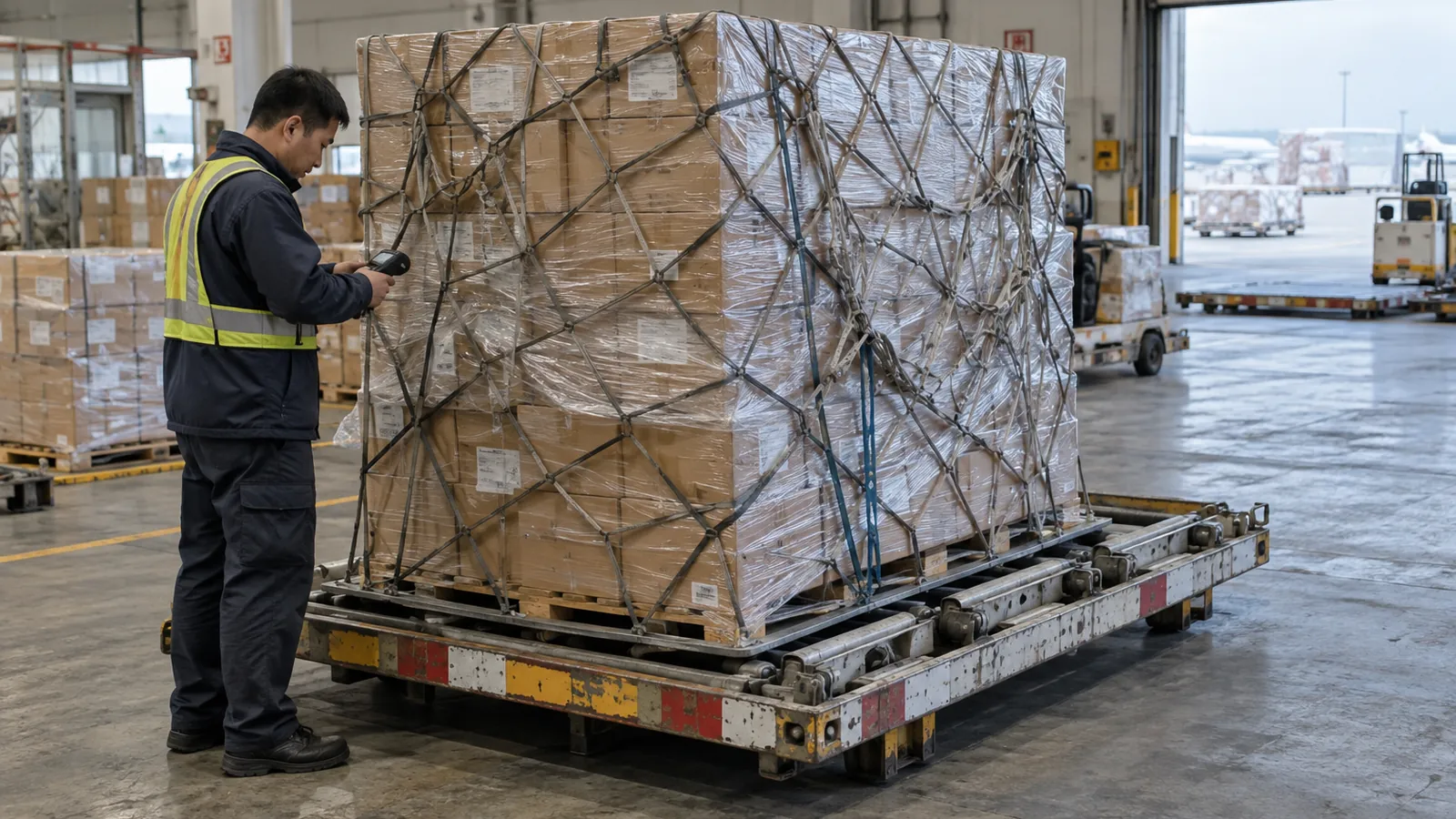
Air cargo and express shipping can both move goods by aircraft, but their service boundaries are different. Compare who collects, clears, hands over and delivers the shipment, then compare total cost and the delivery requirement. Weight alone does not decide which service fits.
Begin with the receiving situation
Imagine two shipments leaving China on the same day. One is a replacement product going to a consumer's home. The other is a pallet of production parts going to a factory with its own broker and receiving dock. They need different destination arrangements even if their goods have similar value.
An integrated express service can simplify a small shipment by providing a connected collection, transport and delivery workflow. A conventional air-cargo booking can give a business more choice over airports, brokers and final transport, but those choices also create coordination work.
Neither description is universal. FedEx's freight service information for China, for example, lists several delivery boundaries for international airfreight. A service called freight is not necessarily airport-only, and a service called express should still have its actual scope checked.
Compare the same beginning and end
Place the collection address and final receiving address at the top of the comparison. For each offer, identify whether the price includes origin handling, export processing, international carriage, destination handling, import clearance and delivery.
Treat airport-to-airport pricing as one component if the customer needs door delivery. Obtain the additional charges and confirm who arranges the work. A low air-cargo rate can be entirely reasonable while still being incomplete for that customer's needs.
For express, check the chargeable weight, destination zone, residential or remote-area treatment and any ancillary clearance charges. The convenience of an integrated network does not mean every possible import service is included.
Cargo shape can matter more than total weight
A dense carton and a bulky display panel can have the same gross weight but different chargeable weight and acceptance conditions. Confirm the packed dimensions and whether the goods can be stacked or handled through the selected network.
General air cargo may be appropriate for palletized or unusually shaped shipments when the routing and handling are arranged accordingly. Express freight products may also accommodate business cargo. Obtain acceptance for the actual pieces rather than assuming that anything above a familiar parcel weight automatically belongs with one provider type.
Regulated goods require a service-specific decision. The fact that an operator accepts one battery configuration does not establish acceptance for loose batteries, damaged batteries or a different origin route.
Customs is a responsibility, not a marketing adjective
Identify the importer, declarant, duty payer and broker. Ask how additional product questions will be answered and whether the recipient must provide information before release. A customer with no import experience may need more coordination than a factory with an established broker.
The IATA air-waybill explanation describes the AWB as a contract of carriage between shipper and carrier. That transport document should not be mistaken for a complete resolution of the customer's import obligations.
When FulfillNexa by SBT prepares goods for either channel, the China-side packing record and commercial information should match the booking. Choosing a different transport network does not remove the need for consistent shipment data.
Use a simple decision screen
Prefer the offer that can demonstrate a workable complete journey. For a straightforward small order, the administrative simplicity of an integrated service may outweigh a modest freight difference. For recurring pallet shipments, separately arranged air cargo may justify the extra coordination if it provides a better overall fit.
For an urgent movement, compare confirmed availability and the latest usable delivery time. A generic transit headline is weaker evidence than a lane-specific booking with defined cutoffs and a destination plan.
For a cost-driven movement, compare all included activities and the financial effect of exceptions. Do not create a universal kilogram threshold from one quotation; minimum charges, density and destination fees change the crossover point.
Before approving either route, name the person responsible for each handover. That final check often exposes the real difference between two offers that initially looked like a simple contest between an airline rate and an express rate.
Sources and verification links
Operational rules can change. Check the linked primary sources and confirm shipment-specific requirements before booking.
- FedEx's freight service information for ChinaFedEx
- IATA air-waybill explanationInternational Air Transport Association