
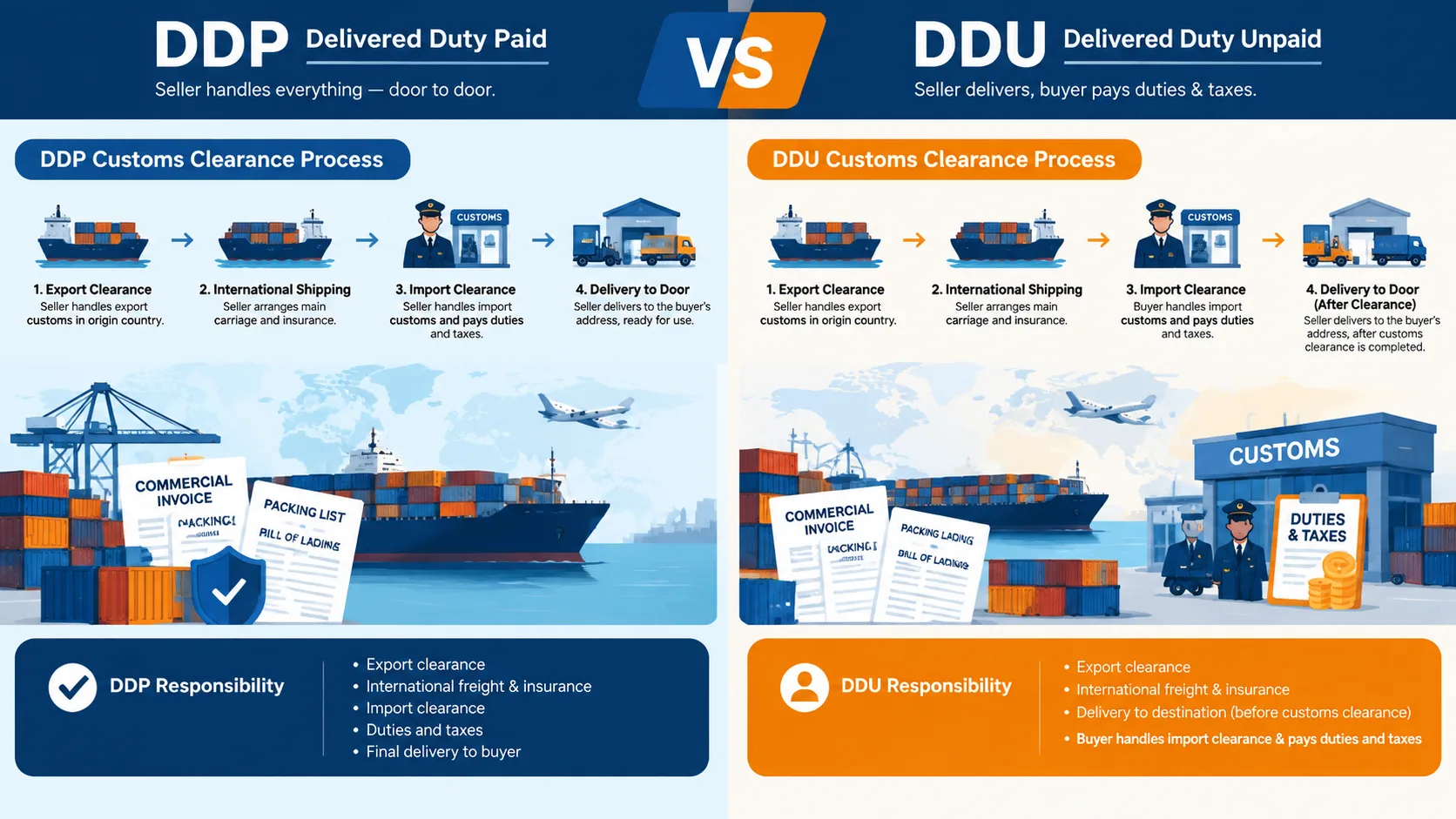
A DDP versus DDU comparison should begin by translating the actual offers into written responsibilities. DDU is a historical Incoterms term and still appears in commercial conversation. It is not one of the eleven Incoterms 2020 rules. If an offer uses it, establish the intended obligations rather than silently treating it as a complete current contract.
The US International Trade Administration's current list includes DAP and DDP. A buyer and seller considering delivery with buyer-managed import clearance can discuss DAP at a named place, with the applicable version stated. Legacy wording needs clarification from the contracting parties.
Compare the same delivery endpoint
Take a hypothetical purchase of stock for a buyer's warehouse. One seller quotes DDP to the warehouse gate. Another quotes freight to a destination terminal and calls it DDU. These are not equivalent journeys, even before duty is considered.
Request the collection and delivery points, mode and service, shipment measurements, currency and quote validity. Specify whether delivery includes an appointment, tail-lift access or another site-specific task. Agree destination unloading separately where needed.
Create one responsibility schedule covering export clearance, international carriage, destination import, onward delivery and additional services. The schedule makes differences visible without assuming that the lowest transport line represents the lowest delivered cost.
Separate who bears a cost from who performs the work
Under DDP, the seller's import obligation still requires a lawful and executable arrangement. Under a buyer-managed import arrangement, the buyer needs suitable information and an authorized representative where required. In either case, identify the actual importer and broker.
ICC discusses national regulatory barriers that can complicate the use of Incoterms rules. A commercial allocation is not permission to disregard destination requirements. Resolve eligibility and representation before shipping.
Use a separate column for the party performing each action and the party bearing its cost. A broker may submit documents while an importer remains responsible for their accuracy. A carrier may initially demand payment from a consignee while the sale contract allocates reimbursement elsewhere. Those arrangements need evidence and a route for resolving mismatches.
Use a matched-cost example
Suppose two offers share the same transport scope. A hypothetical DDP offer is $1,400. A buyer-managed import offer is $1,050, with $250 in estimated import charges and $100 in broker and delivery work payable separately.
Both modeled totals are $1,400. The example does not establish a prevailing freight or tax rate. It shows why comparing only $1,400 with $1,050 creates a false saving. Substitute shipment-specific quotations and verify that no charge appears in both the base price and the extra-cost column.
Then examine uncertainty. Is the import component a fixed commercial price or an estimate subject to reconciliation? Who pays an examination charge? Which party authorizes storage or re-delivery? A more expensive offer can provide a clearer allocation, but clarity must be visible in its terms rather than inferred from the label.
Write the exception plan before the normal plan fails
Consider a customs query, a consignee refusing an unexpected charge, and a delivery vehicle unable to access the site. For each scenario, identify the contact who can decide, the records required and who may authorize additional expenditure.
Agree how a return, abandonment or failed delivery will be handled. Avoid wording that automatically converts every delay into the other party's fault. Distinguish missing buyer information, incorrect seller information, carrier disruption and a regulatory hold.
If insurance is wanted, specify cover, exclusions and the claims process. DDP does not by itself establish that a policy has been purchased. The party bearing transport risk should understand how a loss would actually be funded.
Turn the selected term into operational instructions
The seller, buyer and logistics teams should all receive the same responsibility schedule. FulfillNexa by SBT can use the confirmed China-side scope to organize preparation and handoff, while the named destination parties execute their agreed responsibilities.
Keep the sales contract, freight quotation and warehouse instructions aligned. If one changes, identify the downstream documents that need revision. A useful comparison ends with a clear named place, governing version, complete cost boundary and exception owner. It should not end with a claim that one term is always cheaper or safer.
Sources and verification links
Operational rules can change. Check the linked primary sources and confirm shipment-specific requirements before booking.
- Current Incoterms rulesU.S. International Trade Administration
- ICC national regulatory barriersInternational Chamber of Commerce
- ICC insurance and contract scope questionsInternational Chamber of Commerce