
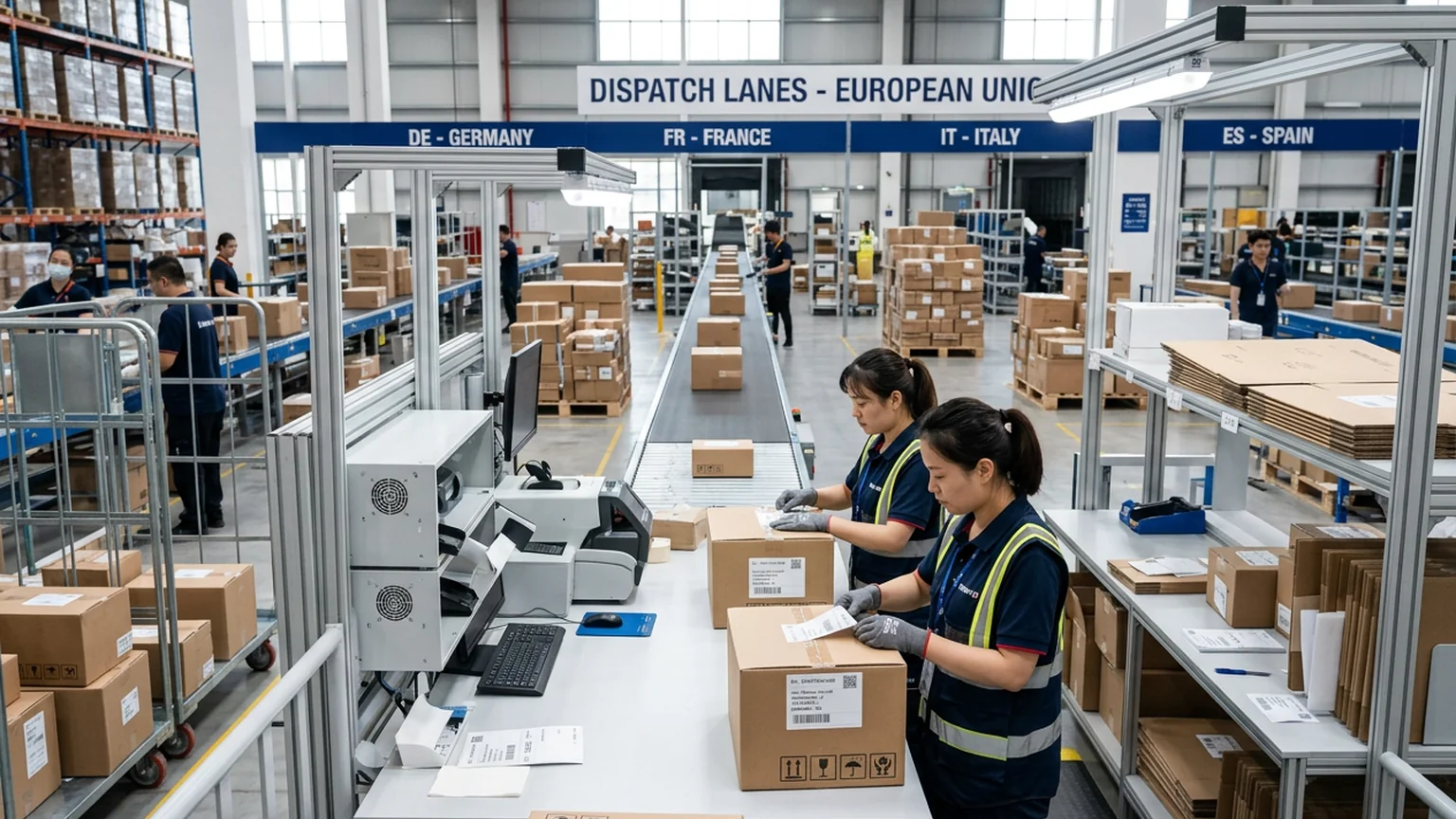
The EU market has specific import requirements
Shipping from China to Germany and the broader EU involves IOSS VAT registration, customs declarations, product compliance checks, and last-mile carrier selection. Since July 2021, the EU removed the €10 VAT exemption for low-value imports, meaning all commercial shipments are subject to VAT.
Sellers must decide whether to collect VAT at checkout (IOSS) or let the carrier collect it at delivery. Each approach affects the customer experience differently.
IOSS: collect VAT at checkout
The Import One-Stop Shop (IOSS) allows sellers to collect EU VAT at the point of sale for shipments under €150. The seller registers for IOSS (directly or through an intermediary), charges VAT at checkout, and includes the IOSS number on the customs declaration.
With IOSS, the parcel clears customs faster and the customer receives it without surprise fees. Without IOSS, the carrier may charge the customer VAT plus a handling fee at delivery.
Customs declaration accuracy
Every shipment to the EU needs a CN22 or CN23 customs declaration with accurate product description, HS code, declared value, and country of origin. Inaccurate declarations cause customs delays, fines, or seizure.
The warehouse prepares the export documentation; the seller confirms product classification and declared value. Electronic customs data (ICS2) must be submitted before the aircraft departs for the EU.
Last-mile carrier selection
Germany has strong domestic carriers (DHL, Hermes, DPD) that offer reliable last-mile delivery. The warehouse should compare eligible cross-border lanes that hand off to these carriers for final delivery.
Compare transit time, tracking coverage, remote-area surcharges, and return capabilities. A cheaper lane with poor tracking creates more customer service issues than it saves in shipping cost.
German packaging law (VerpackG)
Germany's Packaging Act (Verpackungsgesetz) requires sellers shipping to German consumers to register with the LUCID packaging register and pay licensing fees for their packaging materials. This applies regardless of where the seller is based.
The warehouse should confirm the seller's LUCID registration number before shipping to Germany. Non-compliance can result in fines and sales bans.
FAQ
What is IOSS and do I need it?
IOSS lets you collect EU VAT at checkout for shipments under €150. It speeds customs clearance and avoids surprise fees for customers.
How does German packaging law affect me?
Sellers shipping to Germany must register with LUCID and license their packaging. Confirm registration before shipping.
Which last-mile carriers work best for Germany?
DHL, Hermes, and DPD offer strong German coverage. Compare transit time, tracking, and return capabilities per lane.
What happens without IOSS?
The carrier collects VAT from the customer at delivery, often with an additional handling fee. This creates a negative customer experience.
Sources and verification links
Operational rules can change. Check the linked primary sources and confirm shipment-specific requirements before booking.
- EU IOSS guideOfficial source
- Germany VerpackGOfficial source