
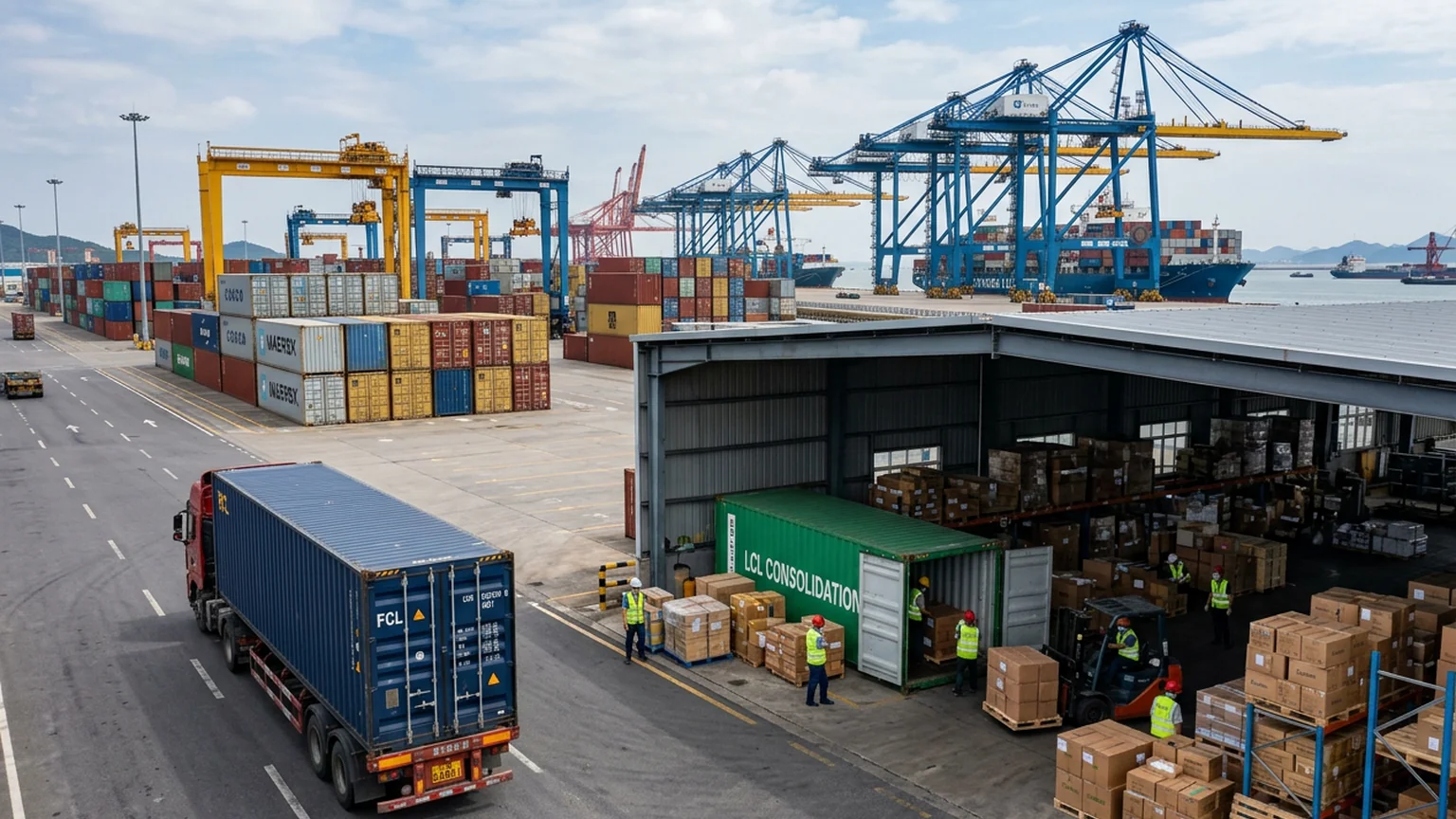
Container shipping has two modes
Full Container Load (FCL) means the seller rents an entire container (20ft or 40ft) for their cargo. Less than Container Load (LCL) means the seller's cargo shares a container with other shippers' goods. The choice affects cost, transit time, risk, and handling.
The breakpoint between LCL and FCL depends on cargo volume, not just weight.
When FCL makes sense
FCL is typically more economical when the cargo fills more than 60-70% of a 20ft container (approximately 15-20 CBM). FCL offers faster transit (no consolidation/deconsolidation stops), lower damage risk (no handling of other shippers' cargo), and simpler customs clearance.
FCL also gives the seller control over loading, sealing, and the entire container's contents. This matters for high-value or sensitive cargo.
When LCL makes sense
LCL suits smaller shipments that do not fill a container. The seller pays only for the space their cargo occupies (per CBM or per ton). LCL is ideal for test shipments, replenishment orders, and sellers scaling up.
The trade-off: LCL takes longer (consolidation at origin, deconsolidation at destination), has higher damage risk (shared container), and involves more handling touchpoints.
Cost comparison framework
Compare total landed cost, not just freight rate. FCL has a fixed container rate; LCL charges per CBM. Calculate the cost per unit for both options at your expected volume.
Include origin charges (documentation, handling), destination charges (deconsolidation for LCL, terminal handling for FCL), customs clearance, and inland transport. LCL destination charges are often higher per unit than FCL.
Risk and insurance considerations
FCL cargo is sealed at origin and opened only at destination, reducing handling and damage risk. LCL cargo is handled multiple times: loaded at the consolidation warehouse, unloaded at the deconsolidation warehouse, and potentially rehandled during transit.
Insurance coverage should reflect the shipping mode. LCL shipments may need higher coverage due to increased handling. Photograph cargo before loading for both modes.
FAQ
At what volume should I switch from LCL to FCL?
Typically when cargo fills 60-70% of a 20ft container (15-20 CBM). Calculate cost per unit for both options.
Is FCL always faster than LCL?
Generally yes—FCL avoids consolidation and deconsolidation stops. But actual transit depends on the route and carrier schedule.
Which has lower damage risk?
FCL—sealed at origin, opened at destination. LCL involves more handling touchpoints and shared container space.
Can I mix LCL and FCL?
Yes. Many sellers use FCL for high-volume SKUs and LCL for test orders or low-volume products. Evaluate per shipment.
Sources and verification links
Operational rules can change. Check the linked primary sources and confirm shipment-specific requirements before booking.
- Freightos — LCL vs FCLOfficial source
- Maersk — Container shippingOfficial source