
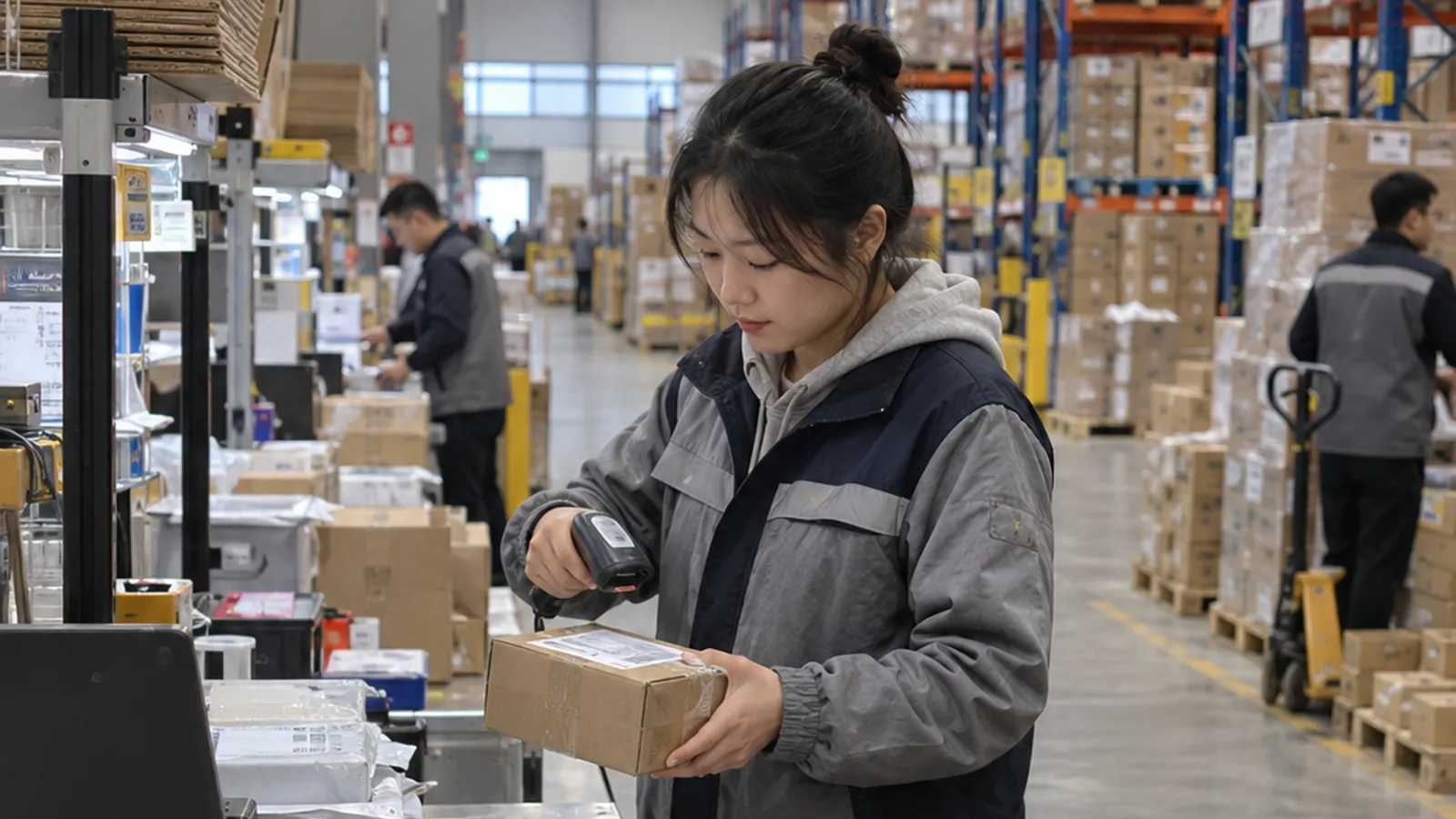
Scaling from 100 to 10,000 daily orders requires a workload model, not a larger version of yesterday’s staffing roster. Order lines, packing complexity, arrival peaks and exception rates determine which part of a warehouse reaches its limit first.
The order volumes in this guide are illustrative planning scenarios. They are not a statement of FulfillNexa’s processing capacity or a promise that any warehouse can achieve the same output.
Convert orders into work at each station
Measure receiving, replenishment, picking, packing, labeling and dispatch separately. Record what each time measurement includes. A picking observation that excludes walking or replenishment cannot be compared with one that includes both.
For an illustrative 10,000-order day, assume 1.6 lines per order, 18 seconds of picking work per line and 45 seconds of packing work per order. Picking requires 16,000 × 18 ÷ 3,600, or 80 labor hours. Packing requires another 125 labor hours.
If a planning assumption allows six productive hours per scheduled person, the arithmetic suggests approximately 14 picking and 21 packing assignments. That is an initial model, not a staffing recommendation. It excludes supervisors, replenishment, breaks outside that allowance, absence, quality work and unusual orders.
At 100 orders, several tasks may fit into one person’s day. At 10,000, the same arrangement can create a bottleneck because each task needs its own capacity and relief plan.
Size for the arrival pattern
Daily averages can conceal a promotion surge. If 40% of the illustrative 10,000 orders arrive in two hours, the operation receives 2,000 orders per hour during that interval.
At an assumed 45 seconds per pack, one continuously productive station completes 80 orders per hour. Matching the arrival peak without a growing packing queue would therefore require 25 stations under those simplified conditions. The daily labor model alone would not reveal that requirement.
The business can instead choose to smooth order release, use an agreed backlog window or constrain the promotion allocation. Those decisions must remain consistent with seller-controlled customer promises and channel requirements.
Include the work created by growth
More orders do not only mean more picks. They also create replenishment tasks, carton consumption, label changes, carrier sorting, customer queries and inventory investigations.
Track the exception mix. A small share of orders requiring manual approval can occupy a disproportionate amount of skilled labor. Improving data quality may therefore release more capacity than adding another packing bench.
Maintain clear stock states as volume grows. Shopify’s inventory-state model illustrates why goods physically present may still be committed or unavailable. Increasing the speed of order release against an inaccurate available-stock figure only creates shortages faster.
Change layout and controls together
Review travel paths, replenishment access, queue locations and parcel staging before installing more stations. A temporary pile of packed cartons can obstruct a route or mix carrier loads even when individual packing output looks healthy.
The US OSHA warehousing overview identifies material handling, vehicles, ergonomics and other relevant hazards. It is a useful hazard reference, not a substitute for the requirements and professional safety assessment applicable to a China facility.
Any layout change should preserve the identification of goods on hold, released orders and completed parcels. Test the end-of-shift reconciliation so unfinished work does not vanish between teams.
Increase volume through observable stages
Use a staged pilot with a representative order mix. Record planned arrivals, actual release rate, queue age, errors and staffing at each stage. Stop expansion when a control fails, rather than compensating indefinitely with unrecorded overtime or manual fixes.
After the pilot, compare the observed bottleneck with the model. Replace guessed handling times with measured ranges and explain differences caused by product mix or congestion.
Approval for the next volume level should identify the limiting station, its tested workload and the recovery plan if an integration or carrier collection fails. That is a more useful scaling commitment than a single impressive daily order number.
Sources and verification links
Operational rules can change. Check the linked primary sources and confirm shipment-specific requirements before booking.
- Warehousing overviewUS Occupational Safety and Health Administration
- Understanding inventory statesShopify