
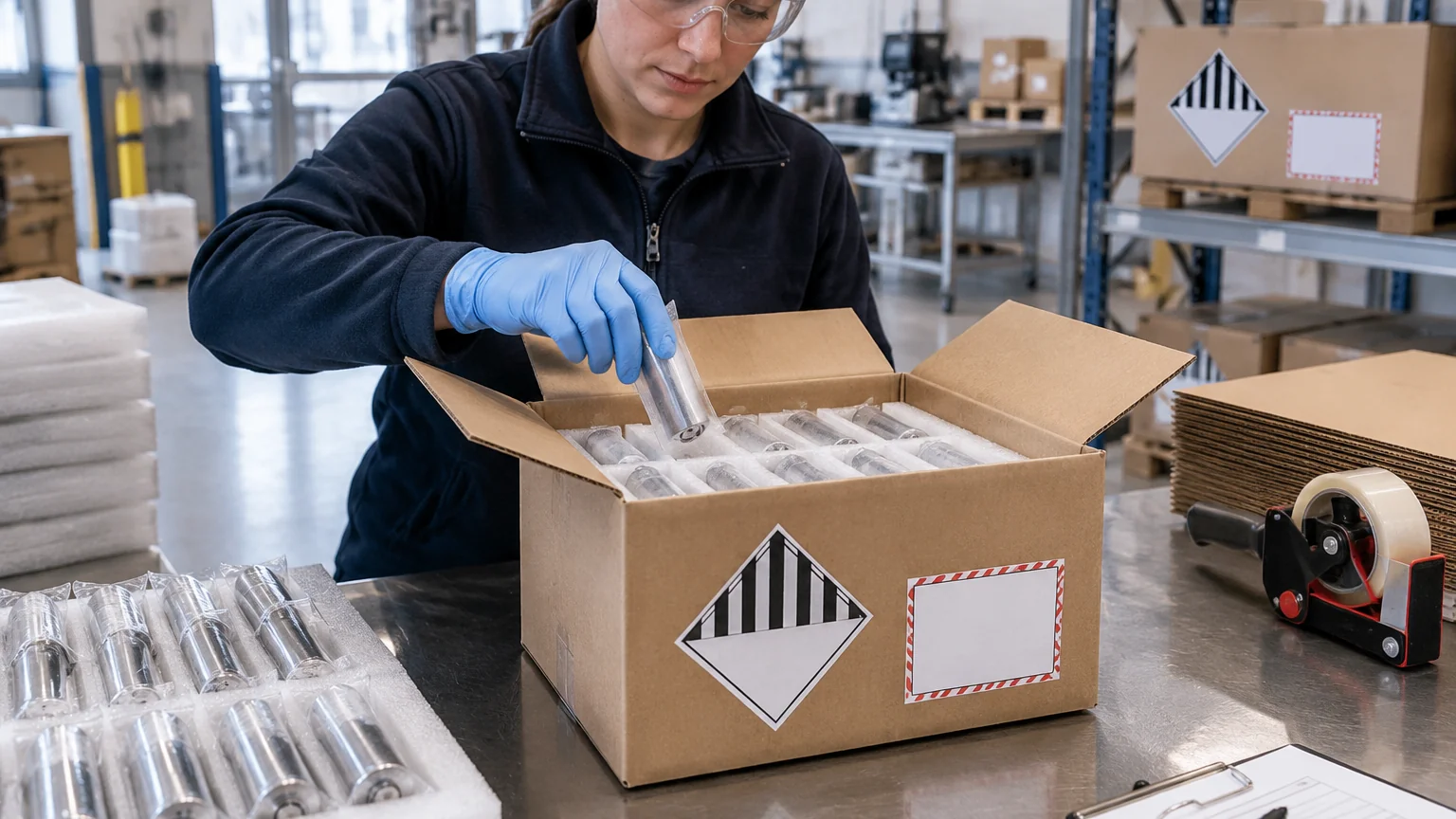
Lithium battery shipping begins with the battery chemistry, configuration and condition — not a generic “battery channel.” Standalone lithium-ion batteries and lithium-ion batteries packed with or contained in equipment follow different entries and packing instructions. Obtain review by appropriately trained dangerous-goods personnel and the accepting operator before packing or booking.
This is a purchasing and document-handoff checklist, not dangerous-goods training or a substitute for the current transport regulations. FulfillNexa must confirm acceptance of the specific cargo and route; this guide does not establish a blanket battery-handling authorization.
Identify the correct entry
| Battery configuration | Common UN entry | Information needed |
|---|---|---|
| Lithium-ion, standalone | UN3480 | Cell or battery rating and configuration |
| Lithium-ion, packed with or contained in equipment | UN3481 | Whether separate from or installed in equipment |
| Lithium metal, standalone | UN3090 | Lithium content and configuration |
| Lithium metal, packed with or contained in equipment | UN3091 | Equipment relationship and lithium content |
Do not use UN3490 or UN3491 for lithium metal batteries. Do not infer classification from a product's sales name; a power bank, for example, should not be casually treated as equipment containing a battery. Have the classification confirmed from the actual design.
Obtain a product-specific document set
Request the exact battery model, manufacturer, chemistry, rating, number of cells or batteries and equipment description. The UN 38.3 test summary must correspond to the product's battery design. An SDS can provide useful information when requested but is not a universal transport approval or a replacement for the test summary.
Preserve the model relationship when a supplier changes components. A report for a similar-looking battery is not enough to establish the status of the replacement.
Do not copy passenger baggage limits into cargo rules
The IATA 2026 guidance distinguishes packing instructions and their conditions. Common small lithium-ion criteria refer to 20 Wh per cell and 100 Wh per battery; meeting those values does not remove all requirements.
State-of-charge restrictions also depend on the instruction. PI 965 standalone batteries have a 30% limit in the ordinary case, and 2026 PI 966 packed-with-equipment provisions require careful review. Do not state that every UN3481 shipment has the same mandatory rule; contained-in-equipment provisions differ. Exceptions and approvals must be handled by qualified personnel.
Use a documented acceptance checkpoint
Before cargo reaches the warehouse, obtain written confirmation of the route's acceptance conditions. Ask the reviewer to identify the applicable packing instruction, section, quantity limits, aircraft restrictions, required marks, labels and documents. Carrier variations can be more restrictive than the baseline.
The warehouse should then work from that approved instruction. Do not improvise dangerous-goods labels from a generated illustration or assume that every package requires identical UN-specification packaging. Images in this article are conceptual visuals, not compliance templates.
Keep abnormal batteries out of routine fulfillment
Damaged, defective, recalled or waste batteries require separate assessment and may be prohibited on the proposed route. Isolate the issue through the company's approved safety procedure and obtain specialist direction. Do not put such goods back into normal saleable stock or disguise them as ordinary electronics.
Product safety compliance in the destination market is a separate question from transport acceptance. A battery that an airline accepts is not automatically a legally saleable consumer product.
Define responsibility across the handoff
The seller should identify the responsible shipper, trained preparer, declaration provider and accepting carrier. Keep the acceptance record linked to the order, battery model, packing version and transport booking. Recheck when the model, quantity, route or packaging changes.
FulfillNexa's Shenzhen 3,000 m² hub focuses on oversized cargo and sea-air / air-sea transshipment, Dongguan's 8,000 m² site focuses on ecommerce warehousing, and Suzhou's 13,000 m² site covers East China consolidation. Neither floor area nor proximity to an airport demonstrates dangerous-goods certification. Confirm the authorized handling location and scope for the actual shipment.
For general routing decisions, see sea versus air freight.
FAQ
Is UN3481 enough information to book a shipment?
No. Packed with equipment and contained in equipment differ, and the battery details, condition and operator requirements also matter.
Does an SDS prove that batteries can fly?
No. It does not replace classification, applicable testing information, packing compliance or operator acceptance.
Can a consumer travel allowance be used for commercial cargo?
No. Passenger baggage provisions should not be substituted for cargo shipping requirements.
Can the same packing instruction be reused after a supplier changes the battery?
Only after the changed design and documentation have been reassessed and approved for the intended shipment.
What happens when a carrier declines acceptance?
The shipment returns to classification, not to the forwarder. Recheck the packing instruction version, the state-of-charge evidence, the mark and label set and the documentation package against what the carrier actually refused, then re-book with the correction named. A refusal accepted without a stated cause is the same shipment arriving at the next carrier unimproved.