
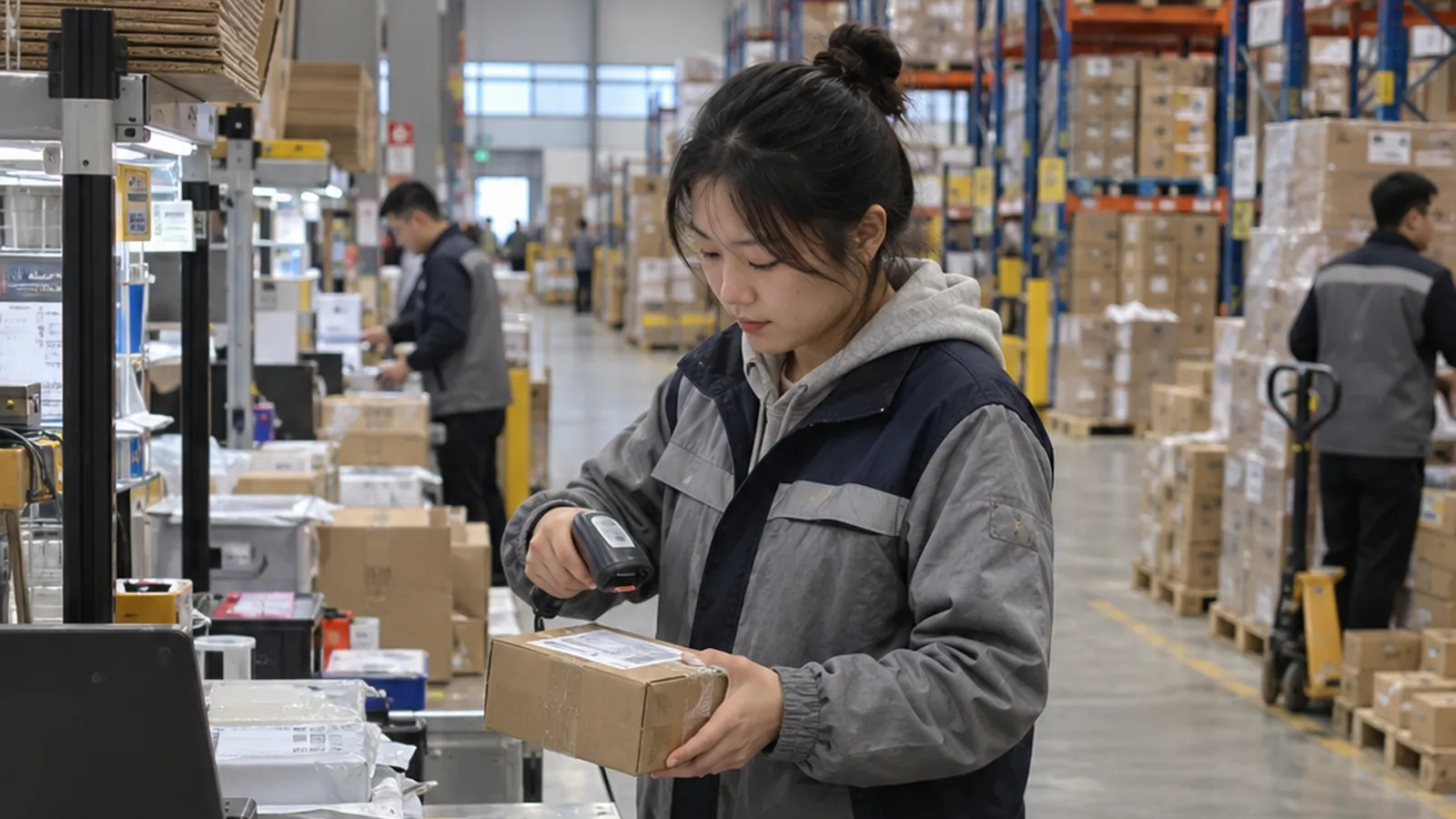
When a brand sources from three or four factories in China, the transport booking is rarely where things go wrong. The failure point is usually the record that should connect a carton in Suzhou to a purchase order raised six weeks earlier in another country. Multi-supplier consolidation turns several unrelated dispatch events into one shipment, and that shipment can only be reconciled if every inbound leg carries an identifier the buyer, the factory and the warehouse all read the same way.
This guide sets out the records worth agreeing before the first carton leaves a factory, how partial arrivals should be handled, and who should be responsible for the final packing list.
The four records that must travel with the goods
A consolidated shipment needs a reference chain, not a single document. Four records do most of the work.
Supplier reference. One code per factory per dispatch, so a carton arriving without a readable PO number can still be traced to its origin and matched to an expected quantity. SKU list. The commercial description of what was ordered, broken down by variant: size, colour, bundle, model. Expected quantity. Units per SKU, stated at the point of dispatch rather than reconstructed on arrival. Carton identifiers. A unique label per carton, ideally carrying the supplier reference, SKU mix and unit count inside it.
These four records do different jobs. The SKU list tells the warehouse what the product is. The supplier reference and carton identifier tell it where that product came from and what is still outstanding. A shipment that has the first two but not the last two usually ends up being reconciled by counting, which is slow and unreliable when a single consolidated load holds dozens of SKUs from different factories.
Where goods are picked up from several factories, the inbound shipment itself should be the unit of record. FulfillNexa's factory consolidation service assigns each inbound shipment a supplier reference, SKU list and expected quantity, and reconciles inbound cartons against the supplied list before goods are combined. That structure works because it matches the way factories actually dispatch: in separate, dated consignments.
Why variant-level identification matters more than carton counts
Totals hide errors. A shipment can have the right number of cartons and the wrong number of medium navy shirts. For apparel, toys and other variant-heavy ranges, the buyer needs a unique SKU or barcode for every size and colour combination, bundles included, agreed before inbound delivery. Similar-looking variants need explicit identification rather than a visual description.
At receiving, compare physical quantities and identifiers against the expected record. Resolving a mismatch while goods are still at the Chinese warehouse gives the buyer an opportunity to obtain clarification from the factory before export. Record the discrepancy against the relevant supplier and SKU, and keep the release decision open until the agreed checks are complete.
What to do when only part of an order arrives
Partial arrival is normal in multi-supplier consolidation, and the record should anticipate it rather than treat it as an exception. Three things need to be decided in advance.
Hold or release. If one supplier's cartons are short, does the consolidated shipment wait, or does it move with the confirmed goods and the remainder follow separately? The decision has a cost either way, and the buyer should make it, not the warehouse under time pressure.
Who is told, and when. A shortfall should be reported against the supplier reference and SKU, with the received quantity and the outstanding balance, so the buyer can chase the factory with specifics.
How the outstanding quantity is tagged. The undelivered balance should stay open on the record rather than being closed when the main shipment departs. Otherwise the next inbound consignment from the same factory has nothing to reconcile against.
Mixed cartons need the same treatment. When several SKUs from several suppliers are packed together, the handling rule should be agreed before goods arrive: whether cartons may be mixed, how they are labelled, how contents are recorded. All of it affects both reconciliation and any downstream preparation such as marketplace inbound labelling.
Who confirms the final packing list
No single party can confirm it alone, and the agreement should say which parts each party owns.
The supplier confirms what it dispatched. The warehouse confirms what it received and checked against the list. The operating agreement should name the party authorised to compare the reconciled record with the order and approve release, whether that is the buyer or another designated party. The freight or export documentation then follows the approved packing list, not the original purchase order.
That split matters because the packing list is a statement of fact about what is physically in the shipment. If it is compiled from purchase orders rather than from receiving records, it will describe the goods that were supposed to arrive. Where preparation work such as FBA labelling or marketplace inbound compliance is involved, the applicable barcode and packaging requirements depend on the marketplace, product and shipment plan, and the approved instructions should be settled before labels are applied. Preparation does not guarantee marketplace acceptance, which is why the reconciled record should be the basis for the release decision.
Records are not the same as guarantees
A sound record structure does not promise that transit will be smooth or that a shipment will clear customs without questions. It does something narrower and more useful: it makes every discrepancy visible at the earliest point where it can still be fixed cheaply, and it gives the buyer a defensible basis for deciding whether to release, hold or split a consolidated load.
Before the first dispatch, confirm the identifier format each factory will print, the quantity basis (units or cartons), the partial-arrival decision rule, the mixed-carton rule and the named owner for final packing-list approval. Those five agreements do more for a multi-supplier shipment than any amount of downstream tracking.
FAQ
Should each carton have its own identifier, or is one label per pallet enough? Per-carton identification is more robust when cartons from different suppliers are combined, because a single mislabelled pallet can hide several carton-level errors. Pallet-level labelling can work where the pallet contents never change between factory and export, but that condition should be stated explicitly rather than assumed.
How should a factory label goods if it does not have barcode printing capability? The buyer can supply pre-printed labels or agree a standard human-readable format that carries the supplier reference, SKU and unit count. The warehouse needs to be able to match the carton to the expected record without relying on a verbal description.
Does consolidation change who is responsible for customs documentation? No. Consolidating several suppliers into one outbound shipment changes the physical handling and the packing-list structure, but the responsibility for accurate export information still needs to be assigned explicitly in the operating agreement.
What happens to goods that fail the receiving check? They should be separated and held for instruction rather than released into the consolidated shipment. The agreed process for nonconforming or damaged goods determines whether they are returned to the supplier, reworked or excluded.