
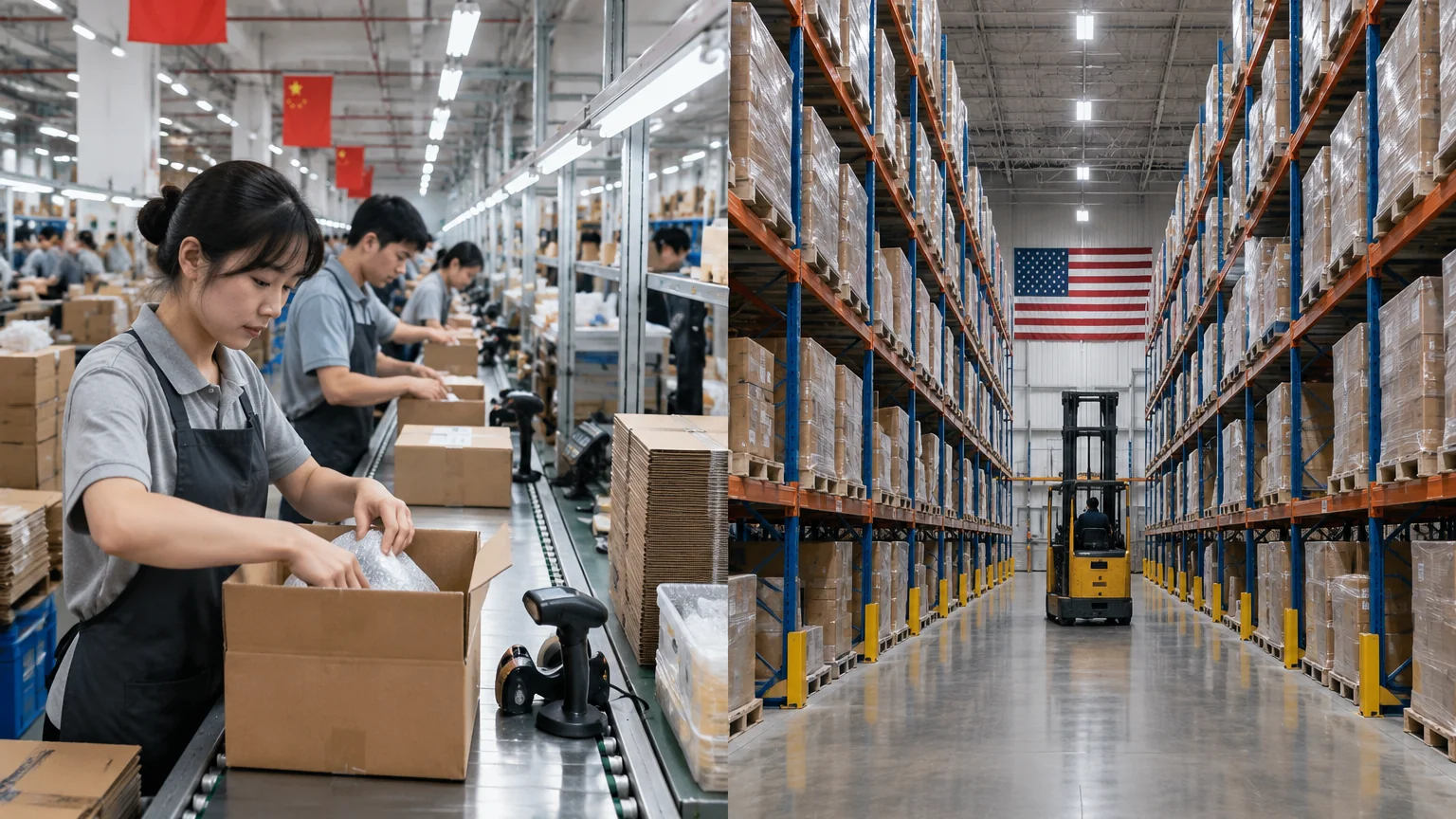
China-direct fulfillment keeps stock near suppliers and sends individual orders overseas. A US warehouse holds imported inventory closer to customers before they order. Neither is universally cheaper. Compare each SKU's demand pattern, packed size, customer delivery expectation and return handling before choosing a model.
The important distinction is when inventory crosses the border. Both models can involve advance procurement and unsold stock. China-direct dispatch does not mean zero inventory capital or risk-free product testing.
Compare the complete operating model
| Decision factor | China-direct | US-held inventory |
|---|---|---|
| International movement | Individual order or parcel program | Bulk replenishment before sale |
| Demand uncertainty | Can retain a shared origin pool | Requires allocation to the US market |
| Delivery promise | Includes an international stage | Primarily domestic after stock receipt |
| Long-tail variants | May avoid scattering stock overseas | Can create slow-moving destination stock |
| Returns | Needs a defined route and cost | Local processing possible if contracted |
| Replenishment risk | Supplier and origin availability | Destination stockout during replenishment |
These are operating characteristics, not guaranteed cost or transit results. A domestic warehouse with poor stock accuracy can still disappoint customers; a well-run origin process still cannot turn international transport into next-day domestic delivery.
Segment the catalog instead of choosing once
Start with three groups: predictable repeat sellers, uncertain variants and oversized or regulated products. Evaluate them separately. A proven compact bestseller may justify US stock, while an experimental color can remain at origin. A large item may need a freight model rather than ordinary parcels regardless of its sales velocity.
Use actual order distribution by postcode and SKU. A blended site-wide average can hide remote-area costs or an expensive multi-item basket.
Build a like-for-like cost comparison
For China-direct, include procurement, origin receiving and storage, pick-and-pack, international delivery, applicable import handling and exceptions. For US stock, include procurement, origin export work, bulk transport, import charges, destination receiving and storage, domestic fulfillment and stock disposal or removal where applicable.
Use the same period and denominator. Show cost per delivered order alongside cash committed to unsold stock. Treat recoverable taxes separately from nonrecoverable cost where your adviser confirms recovery. Do not count bundled last-mile service twice.
A hybrid model needs allocation rules
Keeping some inventory in each country can work, but one system view does not make physically separate stock interchangeable. Define which location is allowed to fulfill which order and how transfers, reservations and returns update availability.
Avoid automatically switching a customer to international delivery after advertising a domestic promise. If the local SKU is out of stock, the customer communication and alternative service need to be consistent with the sale terms.
Test before moving the entire catalog
Choose representative orders and inspect the whole journey: stock allocation, packaging, carrier acceptance, delivery events and customer support. For destination stock, test replenishment receipt and returns grading too. Record exceptions and revised assumptions rather than declaring success after one delivered parcel.
FulfillNexa's China facilities have distinct functions: Dongguan provides 8,000 m² focused on ecommerce warehousing and one-piece fulfillment; Shenzhen provides 3,000 m² focused on oversized cargo and transshipment; Suzhou provides 13,000 m² for East China supplier consolidation and fulfillment support. Any US warehousing or return arrangement should name the actual provider and contract. This article does not claim a FulfillNexa-owned US warehouse.
See the origin fulfillment launch guide and cost worksheet.
What decides the comparison in practice
Weight, price point and reorder frequency decide more than rate cards do. A light, low-volume, unproven listing rarely earns the fixed cost of destination stock; a heavy or fast-repeating one usually does, because the outbound leg and the storage fee are amortized across many units. Sell-through velocity is therefore the first input, not the last. CBP guidance for new importers is worth reading before either model is chosen, because the importer obligations attach to the destination-warehouse path earlier than most sellers expect. Related: how China fulfillment costs are actually quoted.
FAQ
Is China-direct always cheaper for small brands?
No. Parcel size, destination, duties, service requirements and returns can outweigh savings from keeping stock at origin.
Does a US warehouse remove import obligations?
No. Inventory still needs the appropriate import and product-compliance arrangements before domestic fulfillment.
Can slow-moving stock remain in China?
It can be considered, but procurement, origin storage and obsolescence costs still exist.
When should a SKU move to destination stock?
When observed demand, the customer promise and the full cost model support it — not simply because total store revenue crosses an arbitrary threshold.
How does cash timing differ between the two models?
China-direct converts inventory into a payable only when an order arrives, so stock exposure stays low while transit time is charged to the customer experience. A destination warehouse inverts that: goods, freight and duty are paid before the first sale, and the reward is a shorter promise on the listing. The comparison is a working-capital question before it is a shipping-rate question.
Sources et liens de vérification
Les règles opérationnelles peuvent changer. Consultez les sources primaires liées et confirmez les exigences spécifiques à l'envoi avant de réserver.
- CBP importing guidanceSource officielle
- International Trade Administration: shipping and logisticsSource officielle
- CBP — Acceptable versus unacceptable cargo descriptionsSource officielle
- Amazon — Ecommerce fulfillmentSource officielle