
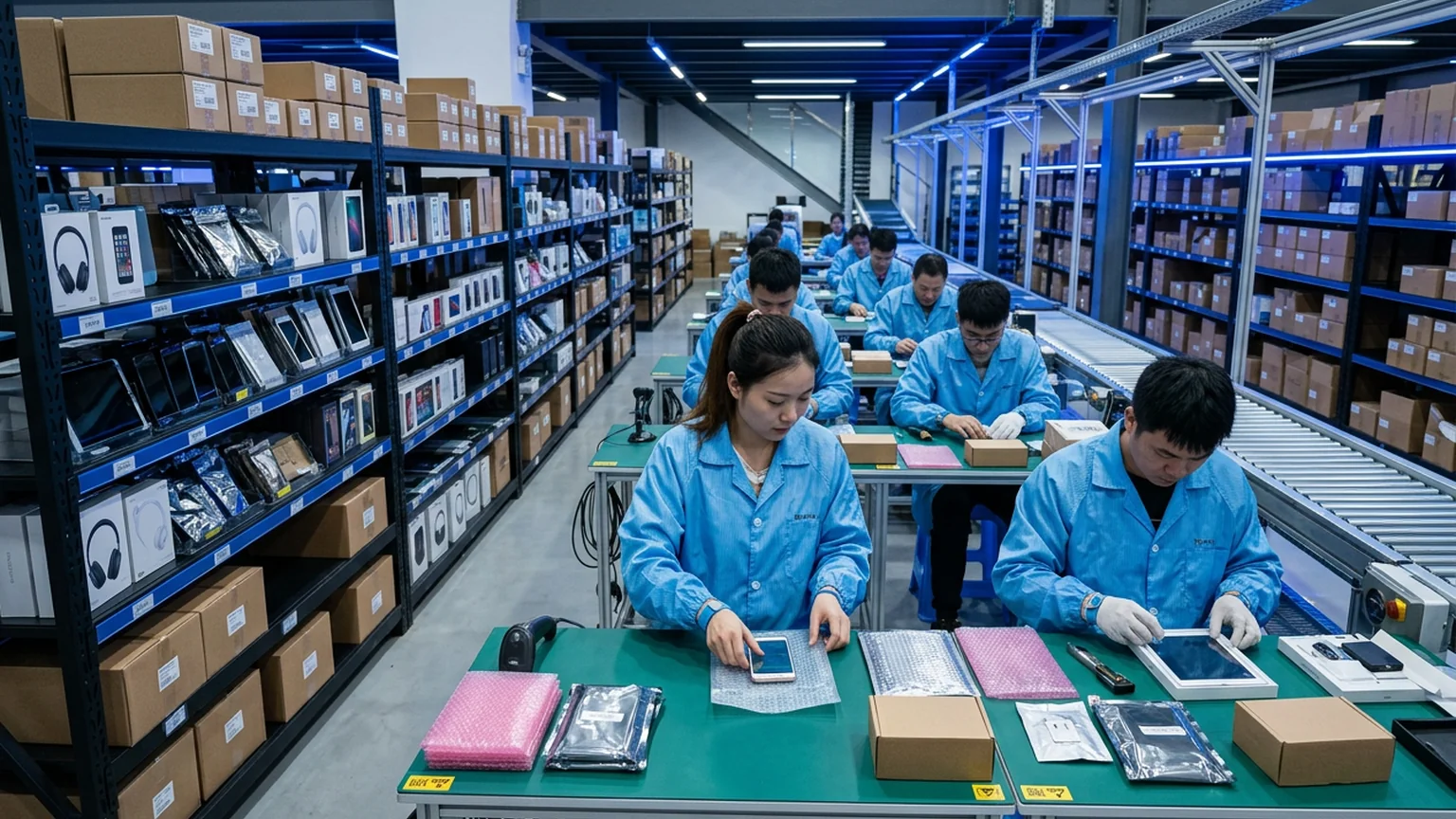
Electronics go wrong in a fulfillment operation in ways that are invisible at the moment they happen. Electrostatic discharge does not leave a mark on a bench. A damp floor does not change a board's appearance until reflow. A misclassified battery does not announce itself until a carrier refuses the shipment or an airline finds it in a parcel declared as ordinary goods.
That is why the useful question about a fulfillment partner is not "can you store electronics" but "what do your controls do about failure modes nobody can see". The answer is either a described process or a shrug, and the shrug is the answer.
ESD control is a program, not a product
A working control set names the standards it follows, because those standards are auditable. ANSI/ESD S20.20 and IEC 61340-5-1 describe what a control program needs: an EPA where static-sensitive work happens, grounded bench systems and wrist straps with routine continuity checks, footwear or flooring where people move, and shielding rather than merely anti-static packaging for items that travel between areas. The pink polybag most warehouses own is a dissipative material; it is not a Faraday shield, and using it where a shielding bag is required is one of the commonest quiet errors in accessory fulfillment.
Two practical checks reveal whether a facility actually runs a program. Ask how often wrist strap testers are used and what happens when one fails. Ask who is allowed to open a shielding bag and whether the bench where that happens is an EPA. A site that handles bare boards, exposed connector assemblies or repair returns should be able to answer both without hesitation.
Moisture is the other invisible failure
Unmounted assemblies and some sub-assemblies are moisture-sensitive according to J-STD-033, which assigns a moisture sensitivity level and a floor life: the time a component may sit in ambient conditions before it must be baked before soldering. For finished retail goods this rarely matters. For boards, modules and units assembled in-house it absolutely does, and it is exactly the kind of requirement a general merchandise warehouse has never heard of. If your product includes bare assemblies, dry-cabinet storage and floor-life tracking belong in the scope.
Battery classification happens at intake, not at booking
Lithium-ion cells and batteries shipped on their own fall under UN3480; batteries packed with or contained in equipment fall under UN3481; lithium metal equivalents are UN3090 and UN3091. The classification drives everything downstream: packing instruction, package limits, the lithium battery mark or Class 9 label, documentation, the 24-hour emergency contact, and whether air movement is permitted at all. UN 38.3 test summaries and the current air-mode restrictions for standalone cells are recurring reasons for refusal.
What has to be true in the warehouse is that the classification is captured per SKU before stock is offered to any channel, along with the cell or pack watt-hour rating and whether the product ships with its battery installed. A device that arrives as "accessory" and turns out to contain a 96 Wh pack is a booking problem, a customs problem and potentially an airline problem. The classification and booking sequence is worked through in our lithium battery shipping SOP.
| Failure mode | When it is discovered | Control that prevents it |
|---|---|---|
| Electrostatic damage | At customer unboxing, or not at all | Defined EPA, grounded benches, strap checks, shielding bags for transit |
| Moisture ingress | At reflow or weeks later in field | MSL awareness, dry-cabinet storage, floor-life tracking, bake policy |
| Battery misclassification | At carrier acceptance or customs | UN number and watt-hour data captured at intake, before lane selection |
| Mixed or substituted unit | At warranty claim | Serial capture at receiving and at outbound, linked to the order |
| High-value shrinkage | At cycle count or never | Caged storage, dual sign-off, audit trail, short-cycle counts |
| Return sold as new | At the next customer | Quarantine, inspection criteria and a distinct stock code for returns |
Serial numbers create the chain of custody
Warranty, insurance and recall questions all resolve to one thing: whether you can prove which unit went to which customer. That requires scanning the serial number or identifier at receiving, against the inbound reference, and again at outbound packing against the order, and keeping the pair linked. Where a product carries both a serial and an IMEI or a regulatory identifier, record both.
Recall response in particular depends on it. In the United States, a consumer product recall turns on identifying the affected lot or serial range and reaching the customers who received it. A warehouse that can only report quantities by SKU cannot support that, and the seller is left reconstructing history from order lines.
High-value handling and returns
Handheld devices, wearables, small electronics and premium accessories are theft-attractive in a way that bulk home goods are not. The controls are conventional: restricted-access storage, camera coverage of the pick face and the pack bench, dual verification on outbound for flagged SKUs, and cycle counts run on a shorter interval than general merchandise. Agree the insurance position and the claim process before the first pallet lands, and be precise about whose interest each policy covers.
Returns deserve their own path. Inspection criteria should say what makes a unit resaleable, whether customer data must be wiped or a device reset before restock, and which stock code returned units join. Anything failing inspection gets photographed, logged and held for the seller's decision. Mixing inspected returns into new stock without a separate code is how a brand discovers its own quality problem through a review thread.
Frequently asked questions
What ESD controls should a fulfillment warehouse have?
A named program, usually referenced to ANSI/ESD S20.20 or IEC 61340-5-1: a defined EPA, grounded bench systems, strap or footwear checks with a documented failure path, and shielding bags rather than dissipative poly for items moving between areas. Ask who may open a shielded bag and where.
How are lithium products handled differently?
They are classified at intake by UN number and watt-hour rating, before any lane is offered. UN3480 covers standalone ion cells and packs, UN3481 equipment with batteries, UN3090 and UN3091 the lithium metal equivalents. Classification drives packing, marking, paperwork and air eligibility.
Do you need serial-number tracking for every electronic?
For anything under warranty, subject to recall, or high enough in value to be theft-targeted, yes. Capture the identifier at receiving and again at outbound against the order, so a later claim resolves to a specific unit rather than a quantity.
Can returned electronics be restocked as new?
Only against written criteria covering cosmetic condition, function, accessories, packaging, and whether a data wipe or reset is required. Failed units are photographed and held for the seller. Returned stock should sit under its own code, not inside the new-stock pool.
What raises the most booking and customs problems?
Silent misclassification. Products described generically, batteries declared as accessories, missing origin or regulatory marks, and declared values that do not match the contents. All of it is preventable by completing product data at intake instead of at booking.
Quellen und Überprüfungslinks
Operative Regeln können sich ändern. Prüfen Sie die verlinkten Primärquellen und bestätigen Sie sendungsspezifische Anforderungen vor der Buchung.
- IATA — Lithium battery shippingOffizielle Quelle
- ESD Association standardsOffizielle Quelle
- U.S. Consumer Product Safety Commission — Business guidanceOffizielle Quelle
- U.S. PHMSA — Lithium Battery GuideOffizielle Quelle