
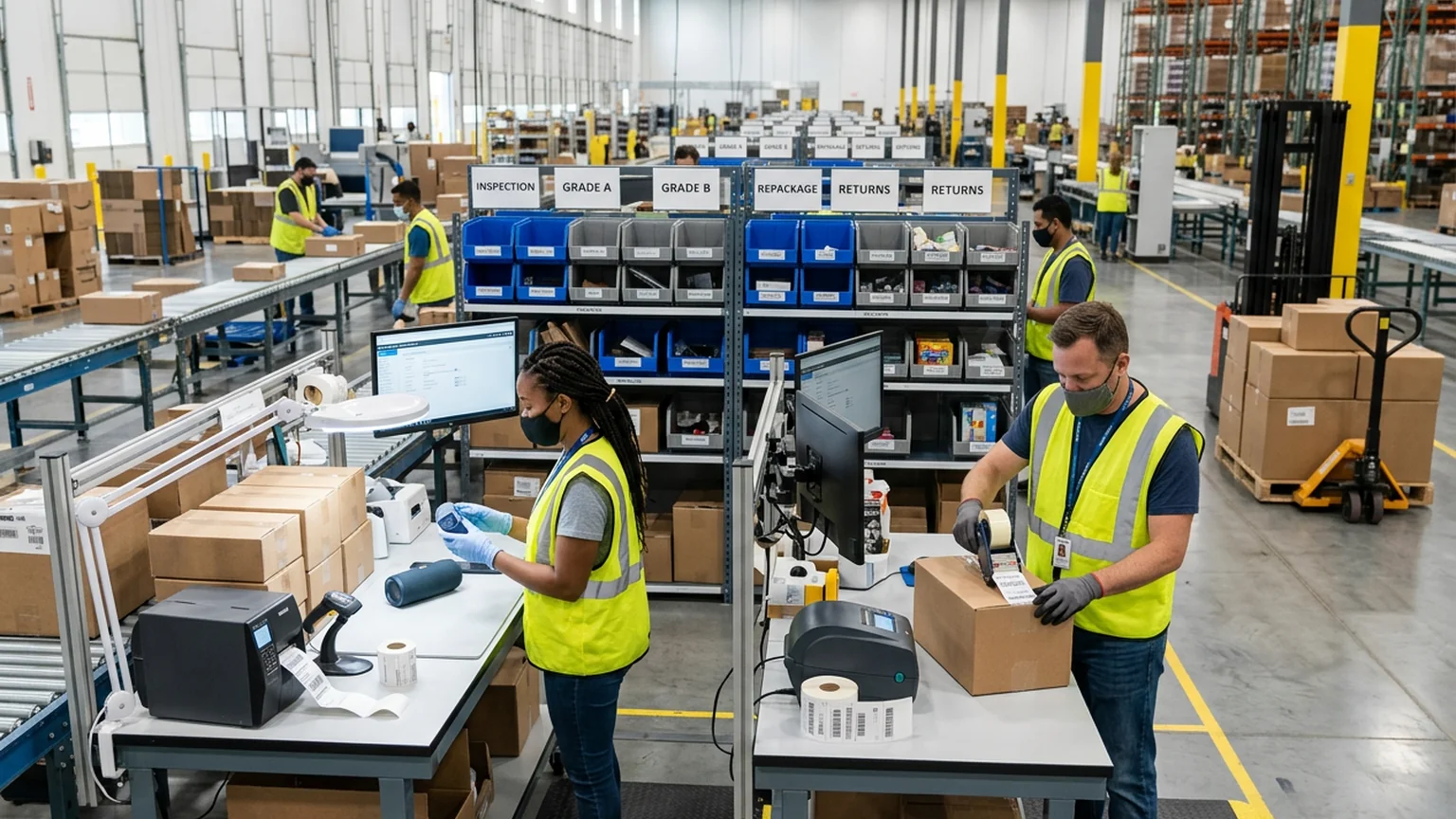
Amazon gives a returned unit a condition status and then a set of routes: return it to a designated address, have it liquidated, or in some programs send it for grading and resale. What the platform does not do is tell you whether the unit is worth recovering. That judgment needs an inspection you can trust, and an inspection you can trust needs criteria written before the first carton moves.
Processing those units in China is where the economics usually work, because labor, relabel capability and proximity to the supplier are all in the same place. It is also where brands create inventory problems, when a return path is improvised instead of specified.
Get the units out of Amazon's network first
Returned customer orders reach the seller through a removal or disposition decision, not automatically. The practical route is usually a consolidated shipment to a fulfillment address the platform will accept, arranged by the seller or a forwarder; international movement of those units is the seller's responsibility to organize. Two consequences follow. Freight and handling on the way back has to be counted into the recovery value before the decision to retrieve anything is made, and the paperwork on that movement needs to describe what is actually in the cartons, because a pallet of used goods declared as new retail stock is a customs problem waiting to be found.
Set the retrieval rhythm at the same time: how often removals are created, what accumulates while waiting, and where the units are held at destination before inspection. Returns that sit unopened for a quarter become a mystery bin.
Write the sellable definition per SKU, not per category
"Good condition" means nothing at an inspection bench. The criteria need to be observable, and different for a sealed skincare item than for a cable, a garment or a small appliance: whether the retail seal is intact, whether the packaging shows shelf wear beyond an agreed standard, whether every accessory and document is present, whether the barcode scans, whether the unit powers and completes a defined function check, whether consumables or batteries are within date, and whether the item carries any condition that would make describing it as new inaccurate.
Units that fail are photographed, logged against the return reason where Amazon provides one, and held for the seller's decision. Restocking is the seller's call, because it is a commercial judgment about the brand's tolerance and the marketplace's rules rather than a warehouse operation.
| Disposition | Applies when | What must be recorded |
|---|---|---|
| Restock as new | Sealed, undamaged, packaging within standard, dates valid | Which units, from which return batch, into which stock code |
| Sell as used or graded | Functional with cosmetic or packaging deficit | The condition grade assigned and the channel it is released to |
| Repack or relabel | Product sound, outer packaging or barcode compromised | New packaging used, new label applied, second-person verification |
| Repair or parts recovery | Fixable within an agreed labor threshold | Work performed, resulting condition, units harvested |
| Supplier claim | Defect traced to the manufacturing lot | Evidence pack, lot reference, claim status |
| Dispose or recycle | Recovery value below handling cost | Authorization, method, quantity, witness record |
Relabeling is a verification task
A recovered unit usually needs fresh packaging, a fresh FNSKU or a new barcode for the channel it is going to, and sometimes a new label set for a different marketplace. The materials and approved label files have to be on hand before the batch starts, not assembled mid-flow. Each relabeled unit should be checked by a second person against the reference before it joins any sellable pool, because a mislabeled return does not present as a returns problem later; it presents as a customer receiving the wrong item.
Keep returned stock identified separately from new stock, with its own code and location. Blending the two destroys the accounting trail, makes quality analysis impossible, and eventually sends a unit to a customer who reports it as second-hand. Where a return may have been opened, used or partly consumed, the marketplace's own condition rules decide what it can be sold as. Relabeling does not convert a used item into new inventory, and a provider who suggests otherwise is describing a policy violation.
Traceability turns a cost center into information
Every unit needs a short record: the removal or return reference it arrived under, the reason code where one exists, the inspection result, the action taken, and the new identifier if it was relabeled. Reconcile the monthly totals against the seller's Amazon removal and returns data, and investigate differences before the next batch rather than at year end.
The payoff is not tidiness. A return stream with reason codes attached to inspection findings tells you whether a problem is packaging fragility, a specific production lot, an accessory that goes missing, a description that oversells the product, or a marketplace whose customers behave differently. That analysis usually pays for the inspection program on its own, and it points at the supplier conversation worth having.
For the wider decision of what to retrieve, what to dispose of locally and where each market's economics invert, the framing is set out in our cross-border returns playbook.
Frequently asked questions
Can a China warehouse receive Amazon FBA returns directly?
Units have to be routed out of Amazon's network first, usually through a removal or disposition decision to an address the platform accepts, with any international movement arranged by the seller or a forwarder. The warehouse then receives, inspects and dispositions them against agreed criteria.
How is sellable condition decided?
The seller defines observable per-SKU criteria before returns arrive: seal integrity, packaging standard, accessory completeness, barcode scan, function check and date validity. Anything ambiguous is escalated rather than resolved at the bench.
Can relabeled returns be listed as new again?
Only where the item genuinely meets the condition the listing claims and the marketplace's rules for that condition. Relabeling changes the label, not the history of the unit. Opened, used or partly consumed goods belong in a used, graded or liquidation route.
What should the returns report contain?
Arrival reference, reason code where available, inspection outcome, disposition taken, new identifier if relabeled, and photographs of failures. Monthly totals should reconcile against the seller's own removal and returns data.
Is recovering returns to China ever not worth it?
Frequently, for low-value items, where outbound freight plus recovery handling exceeds resale value. The useful response is a threshold rule set in advance, plus a local disposition option, so nobody is deciding unit by unit under time pressure.
Quellen und Überprüfungslinks
Operative Regeln können sich ändern. Prüfen Sie die verlinkten Primärquellen und bestätigen Sie sendungsspezifische Anforderungen vor der Buchung.
- Amazon — FBA returnsOffizielle Quelle
- Amazon — Inventory adjustmentsOffizielle Quelle
- Amazon — Multichannel fulfillment and returnsOffizielle Quelle
- European Commission — UCC guidance on returned goodsOffizielle Quelle
- CBP — Duty-free treatment for qualifying returned goodsOffizielle Quelle