
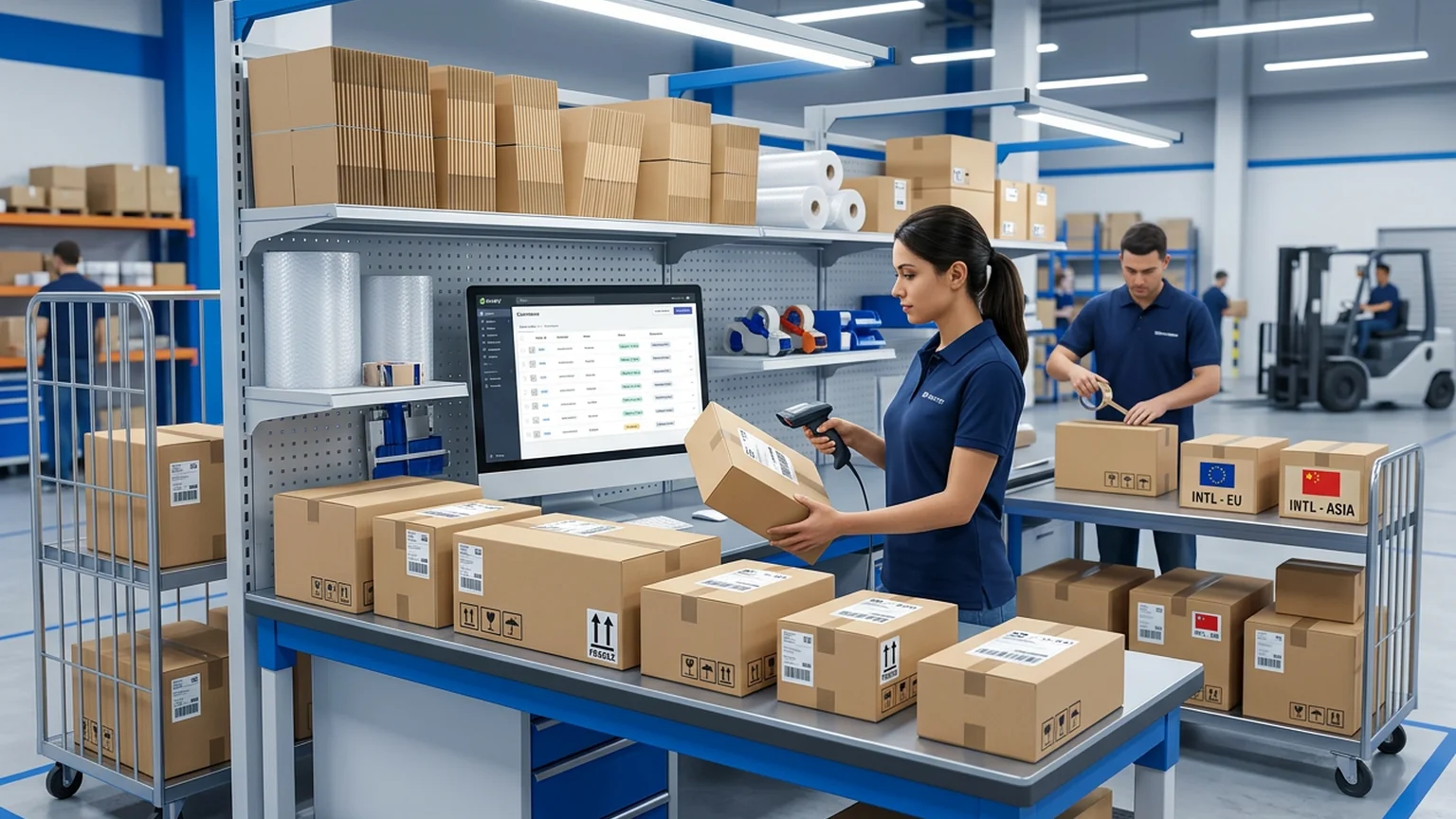
A packing insert can be physically correct for one campaign and wrong for another. The warehouse needs the merchant's active instruction for the destination and order group being packed.
For insert work, the merchant should supply an approved file and state which orders receive it.
Map each insert to the intended order group
Create an approved insert list by destination or customer group, with a version reference, effective date and the exact file. Identify who owns the wording and any required destination review. A translation or commercial offer should be approved by the merchant; the warehouse should not invent local legal wording or customer promises.
At setup, match a sample order's destination and product to the selected insert. Keep different versions in clearly separated locations. Record the quantity used, balance remaining and any version change during the job. If an order's destination changes after packing, review the insert as well as the shipping label.
For stock sent to an overseas site, agree whether inserts are added before export or during local fulfillment. A pack prepared for one market should not silently become the default for another because its carton size is convenient.
Compare the preparation patterns
For a hypothetical 600-order batch, assume printing costs US$0.08 per insert and insertion takes 12 seconds per order at $24 per hour. Those tasks total $96. If three destination versions each require ten minutes of setup and a sample check, add $12, giving $108. These assumed costs exclude translation, legal review, commercial approvals and transport.
Direct parcels can use the approved insert selected for the actual recipient. Bulk air replenishment can keep destination-specific stock separate or leave insertion for an agreed local process. Ocean replenishment needs the same version and inventory planning, especially if a time-limited insert may no longer be suitable when used. Do not assume a transit duration; compare against the provider-confirmed plan and the insert's actual validity.
Ask for complete costs for origin insertion versus destination insertion, including any additional stock separation or handling. A common insert may simplify work only if the merchant approves it for all intended orders. Retain the used version against the dispatch so customer service can identify the document the recipient actually received.