
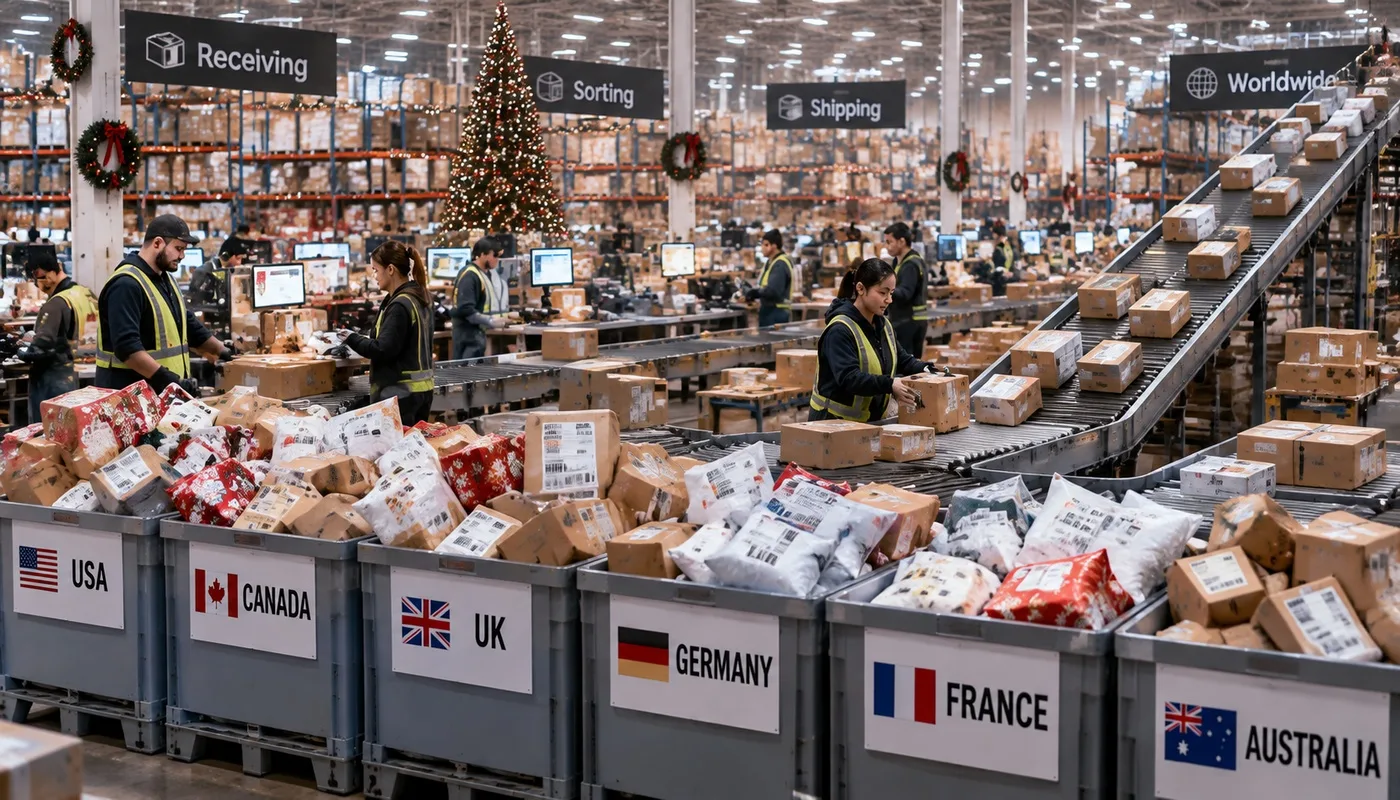
Q4 — October through December — is when most cross-border ecommerce operators see their highest order volumes and their worst fulfillment performance at the same time. Air cargo capacity tightens, carrier sortation facilities reach saturation, and customs processing times extend. For sellers running one-piece dropshipping from China via small-parcel direct shipping, the operational question is not whether volume will increase but whether the fulfillment workflow can absorb the surge without collapsing delivery promises.
FulfillNexa by SBT manages this seasonal transition from its 8,000 m² Dongguan fulfillment center, which handles ecommerce single-order fulfillment year-round. The site's multiple loading docks and staged receiving workflow are designed for volume variation. This guide covers the specific planning steps for small-parcel direct shipping through Q4, based on the operating patterns observed across prior peak seasons.
Q4 capacity timeline: when each bottleneck hits
| Period | Air cargo capacity | Carrier sortation | Customs processing | Fulfillment center | Action window |
|---|---|---|---|---|---|
| Early October | Normal | Normal | Normal | Normal | Last chance to confirm carrier contracts and lane allocations |
| Late October | Tightening (pre-singles day / pre-Halloween) | Normal | Normal | Ramping | Confirm volume forecast with carrier; lock space |
| Early November | Tight (Singles Day 11.11 surge from all China shippers) | Tightening | Normal | Peak preparation | Singles Day volume may delay non-priority parcels |
| Mid-November | Tight (Black Friday / Cyber Monday orders dispatched) | Tight | Normal | Peak operations | Black Friday orders must be dispatched within platform SLAs |
| Late November – Early December | Constrained (holiday volume peak) | Saturated in destination countries | Slowing | Peak operations | Last safe dispatch window for Christmas delivery |
| Mid-December | Severely constrained | Saturated | Severely slowing | Peak winding | Only express lanes viable for pre-Christmas delivery |
| Late December – Early January | Recovering | Recovering | Backlog clearing | Normalizing | Process returns; reconcile exceptions |
The critical insight: the bottleneck shifts from origin (China air cargo) to destination (carrier sortation and customs) as the season progresses. In October, the constraint is securing air space. In December, the constraint is getting parcels through destination-country sortation and last-mile networks before the holiday cutoff.
Five pre-season actions that reduce peak-season failures
- Confirm carrier capacity allocations by mid-October. Do not wait until November to check whether your carrier can handle your projected volume. Most carriers finalize peak-season capacity allocations in October. Secure written confirmation of lane availability and volume limits.
- Build a dispatch cutoff calendar. For each destination country, identify the last dispatch date that still allows pre-holiday delivery. Work backward from the holiday date using the carrier's published peak-season transit time (not the off-peak time). Publish this calendar internally and on customer-facing pages.
- Pre-stage packaging materials. Mailer, carton, label, and insert supply chains can be disrupted by the same peak-season pressure that affects parcel volumes. Confirm packaging inventory by mid-October for the full Q4 forecast.
- Agree on peak-season exception handling rules. Define in advance who authorizes carrier substitutions, lane changes, or service downgrades when the primary lane is at capacity. Document the approval chain and cost limits.
- Separate peak and non-peak SKUs. Not every product needs to ship within the same timeline. Identify which SKUs have holiday delivery promises and which can tolerate standard transit times. Route them through different lanes if necessary.
Volume planning: how to forecast peak-season parcel volume
| Input | Source | Typical accuracy | Planning use |
|---|---|---|---|
| Prior-year Q4 order volume | Internal sales data | High (if same product mix) | Baseline forecast |
| Current-year growth rate | YTD trend vs prior year | Medium | Growth adjustment |
| Promotional calendar | Marketing plan (Black Friday, Cyber Monday, holiday campaigns) | Medium | Surge timing |
| New product launches | Product roadmap | Low | Uncertainty buffer |
| Carrier capacity confirmation | Written carrier allocation | High (until exceeded) | Hard ceiling |
A practical approach: take the prior-year Q4 peak week volume, apply the current-year growth rate, add a 20% buffer for promotional surges, and compare against the carrier's confirmed capacity. If the forecast exceeds confirmed capacity, either secure additional allocation or plan a secondary lane.
Peak-season dispatch rules for small-parcel direct shipping
| Rule | Rationale |
|---|---|
| Dispatch confirmed orders within 24 hours of payment clearance | Reduces backlog accumulation; meets most platform SLAs |
| Do not hold orders for batch consolidation during peak | The cost of a slightly higher per-parcel freight is lower than the cost of missed delivery promises |
| Use the primary lane until it is confirmed full, then switch to secondary | Avoids premature lane-switching that fragments tracking visibility |
| Record dispatch timestamp separately from carrier scan timestamp | Platform SLAs typically measure from order confirmation, not carrier scan |
| Flag any parcel without a carrier scan within 48 hours | Early exception detection prevents delivery promise failures from compounding |
When to stop accepting pre-holiday orders on economy lanes
The answer depends on the destination, but a general guide:
| Destination | Last economy dispatch for pre-holiday delivery | Last express dispatch |
|---|---|---|
| USA | Approximately December 8–12 | Approximately December 16–18 |
| UK | Approximately December 6–10 | Approximately December 14–16 |
| EU (Germany, France) | Approximately December 5–9 | Approximately December 13–15 |
| Canada | Approximately December 6–10 | Approximately December 14–16 |
| Australia | Not time-critical (summer, no major gift holiday) | N/A |
These dates are approximate and vary by carrier, service tier, and actual destination postcode. Confirm with the specific carrier for the current year. Always publish the cutoff date to buyers before they order, not after a late parcel triggers a complaint.
Post-peak recovery: January exception handling
After the holiday volume subsides, the fulfillment operation shifts from dispatch to exception resolution:
- Reconcile all open shipments. Identify parcels still in transit, stuck in customs, or returned to sender. Close or escalate each one.
- Process returns. Cross-border returns from Q4 typically peak in January. Have a defined workflow for inspection, restocking, refund, or disposal.
- Review carrier performance. Compare actual transit times against published estimates. Document any lane that consistently underperformed for next year's planning.
- Update the cutoff calendar. Use actual delivery data from this Q4 to calibrate next year's cutoff dates.
- Reconcile inventory. Physical stock count against system records. Investigate and resolve discrepancies before the next cycle.
What to send for a peak-season capacity review
Provide the following to assess Q4 readiness:
- Projected Q4 order volume by month and by destination country
- Current carrier contracts and confirmed peak-season allocations
- Product mix and any new SKUs not shipped in prior Q4
- Platform SLA requirements (Amazon, TikTok Shop, eBay, Shopify)
- Current exception handling workflow and escalation contacts
- Packaging material inventory and reorder timeline
With this data, a fulfillment team can identify capacity gaps, recommend lane allocations, and build a dispatch cutoff calendar before the peak window opens. See the small parcel direct shipping cost guide for the baseline cost structure and the multichannel integration guide for channel-specific SLA requirements.
FAQ
When should Q4 peak-season planning start for China-origin small-parcel shipping?
By mid-September at the latest. Carrier capacity allocations are typically finalized in October. Sellers who wait until November to check availability may find that their preferred lanes are already committed to higher-volume shippers.
What is the last safe dispatch date for pre-Christmas delivery from China?
For economy air lanes, approximately December 8–12 for the US and December 5–9 for most EU countries. For express lanes, approximately December 14–18 depending on destination. These dates vary by carrier and should be confirmed for the current year.
How does Singles Day (11.11) affect small-parcel shipping from China?
Singles Day (November 11) is the largest ecommerce event in China. Air cargo capacity from Chinese airports tightens significantly as all shippers dispatch simultaneously. Non-priority parcels may experience 3–7 day delays in the week following 11.11. Plan promotional dispatch schedules around this constraint.
Can the same fulfillment center handle both regular and peak-season volume?
Yes, if the facility has been designed for volume variation. FulfillNexa's Dongguan site operates with staged receiving and multiple loading docks that accommodate seasonal surges. The key is confirming carrier capacity and packaging supply before the peak, not during it.
What happens to parcels dispatched in December that do not arrive before the holiday?
They remain in transit or enter the carrier's post-holiday backlog. The seller's obligation to the buyer depends on the published delivery promise and the platform's policy. This is why publishing a dispatch cutoff date before accepting orders is essential — it sets buyer expectations and reduces post-holiday dispute volume.
Sources and verification links
Operational rules can change. Check the linked primary sources and confirm shipment-specific requirements before booking.
- CBP holiday season import guidanceOfficial source
- Universal Postal Union peak period advisoryOfficial source
- Royal Mail international peak surcharge guidanceOfficial source