
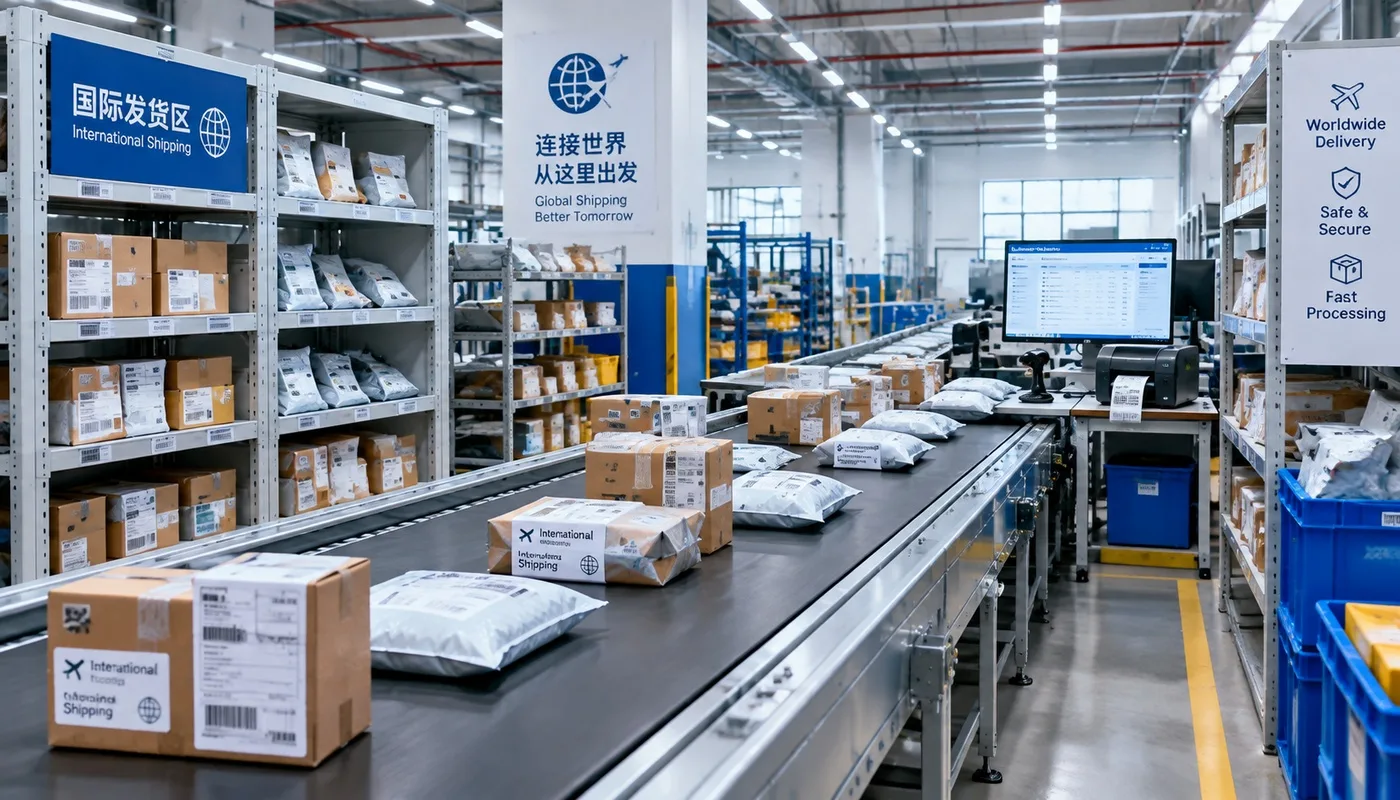
The cost of shipping a small parcel directly from China to a US, EU or UK buyer is made up of at least five separate charges: origin handling, line-haul freight, customs clearance, last-mile delivery and any applicable duties or taxes. Most published rate cards show only the freight leg. The actual per-parcel bill can differ significantly once handling fees, fuel surcharges, address corrections, dimensional-weight adjustments and destination taxes are included.
FulfillNexa by SBT operates small-parcel direct shipping from its 8,000 m² Dongguan fulfillment center for ecommerce single-order fulfillment and its 3,000 m² Shenzhen hub for oversized and sensitive-cargo lanes. The two sites serve different operating roles. This guide uses a standard 0.5 kg to 2 kg parcel profile — the most common range for one-piece dropshipping and direct-to-consumer orders — to show where the cost comes from and which variables move it.
Per-parcel cost structure: what you actually pay
| Cost component | What it covers | Typical range (0.5–2 kg parcel) | Variable or fixed |
|---|---|---|---|
| Origin handling | Receiving, QC, pick, pack, label, manifest | $0.30–$0.80 / parcel | Mostly fixed per parcel |
| Line-haul freight | Air transport or economy parcel post | $1.50–$6.00 / parcel | Varies by weight, lane, service tier |
| Fuel surcharge | Carrier fuel adjustment | 5–25% of line-haul | Variable, updated weekly/monthly |
| Customs clearance | Entry filing, classification, documentation | $0–$3.00 / parcel | Depends on destination and entry type |
| Duties & taxes | Tariff, VAT/GST, any other levy | 0–25% of declared value | Depends on product, value, destination |
| Last-mile delivery | Domestic carrier handoff and delivery | Included–$2.00 | Depends on lane and service level |
| Surcharges | Address correction, re-delivery, returns, storage | $0–$5.00+ / event | Only when triggered |
A 0.5 kg parcel from Dongguan to a US residential address on an economy air lane might cost $2.50–$4.00 all-in for freight and handling before duties. The same parcel to Germany on an IOSS-registered lane might add EUR 0.50–1.50 for VAT facilitation. The numbers change with weight, destination postcode, product category and service tier. The table above is a structural guide, not a quotation.
Lane-by-lane comparison: US, EU, UK
| Lane | Transit time (economy) | Transit time (express) | Entry method | Key cost driver |
|---|---|---|---|---|
| China → USA | 7–15 business days | 3–7 business days | CBP entry; de minimis suspended since Aug 2025 | Duties on most low-value parcels; Section 301 tariffs on China-origin goods |
| China → EU (Germany, France, etc.) | 8–18 business days | 4–8 business days | IOSS for consignments ≤ EUR 150; standard import above | VAT at destination rate; IOSS simplification fee |
| China → UK | 7–15 business days | 3–7 business days | HMRC C79 certificate or postponed VAT accounting | VAT at 20%; customs duty above GBP 135 |
| China → Canada | 8–16 business days | 4–8 business days | CBSA entry; CDN 20 de minimis still in effect | Lower de minimis threshold means fewer duty-free parcels |
| China → Australia | 7–14 business days | 3–7 business days | ABF entry; AUD 1,000 duty-free threshold | GST on low-value imports since July 2018 |
The US lane has become materially more expensive since the de minimis suspension. EU lanes are relatively stable under IOSS. UK lanes require separate VAT and customs planning post-Brexit. Always confirm the current entry method for the actual product, value and destination before quoting a landed cost to the buyer.
Weight-tier pricing: how billable weight works
Small-parcel carriers typically charge by the greater of actual weight and dimensional weight. Dimensional weight is calculated as length × width × height ÷ a carrier-specific divisor (commonly 5,000 for metric or 139 for imperial).
| Packed parcel | Actual weight | Dimensional weight (25×20×10 cm) | Billable weight | Impact |
|---|---|---|---|---|
| Phone case in poly mailer | 0.15 kg | 1.0 kg | 1.0 kg | Dimensional weight dominates |
| T-shirt in standard mailer | 0.25 kg | 1.0 kg | 1.0 kg | Dimensional weight dominates |
| Toy in fitted carton | 0.8 kg | 1.0 kg | 1.0 kg | Close to break-even |
| Ceramic mug in padded box | 1.2 kg | 1.0 kg | 1.2 kg | Actual weight dominates |
| Book set in corrugated box | 1.8 kg | 1.5 kg | 1.8 kg | Actual weight dominates |
Packaging choice directly affects cost. A product in oversized retail packaging can double the billable weight. Confirm the packed dimensions and weight before selecting a service lane. The air small parcel preparation guide covers product data and packaging requirements in detail.
Direct shipping vs overseas warehouse: when each model wins
| Factor | Direct small parcel from China | Pre-positioned overseas warehouse |
|---|---|---|
| Inventory risk | Stock stays in China until sold | Inventory imported before demand is confirmed |
| Per-order cost | Higher per-parcel freight | Lower per-parcel domestic delivery |
| Cash tie-up | Lower — pay as orders ship | Higher — bulk freight + destination storage |
| Delivery speed | 7–18 days depending on lane | 1–3 days domestic |
| Returns handling | Complex — cross-border return | Simpler — domestic return address |
| Best fit | Demand testing, long-tail SKUs, low-volume lanes | Proven SKUs, high-volume lanes, Prime-eligible programs |
| Startup cost | Low — no destination warehouse contract | Higher — destination lease, staffing, compliance |
For most new product launches or niche categories, starting with direct small parcel reduces upfront commitment. Once a SKU proves consistent daily volume on a specific lane, migrating to a hybrid model — direct for testing, overseas warehouse for proven lanes — can improve both delivery speed and per-order cost. The China dropshipping vs US warehouse comparison provides a deeper cost model.
Five variables that move the cost most
- Packed weight and dimensions — The single largest controllable cost factor. Every gram and centimeter of packaging affects the billable basis.
- Destination postcode — Remote or island postcodes carry surcharges. US Zone 8, Australian regional areas, and northern Canada can add $1–$4 per parcel.
- Product classification — Incorrect or missing HS codes lead to customs delays, storage fees, and re-classification charges. Invest in classification review before launch.
- Service tier selection — Economy air parcel post can be 40–60% cheaper than express courier for the same lane. The trade-off is transit time and tracking granularity.
- Volume commitment — Most carriers offer tiered pricing based on monthly parcel volume. A commitment of 500+ parcels/month can reduce per-parcel freight by 15–30% compared to ad-hoc rates.
What to provide for an accurate cost review
To receive a meaningful cost estimate, prepare the following for each product and destination combination:
- SKU list with packed weight and dimensions (not product weight alone)
- Product description, material, and any regulated attributes (batteries, liquids, etc.)
- Destination countries and representative postcodes
- Expected monthly order volume per lane
- Required delivery experience (standard vs express, tracking depth)
- Customs and tax arrangement (DDP, DAP, IOSS-registered, or buyer-responsible)
With this data, a fulfillment team can provide lane-specific pricing rather than a generic range. See the fulfillment cost breakdown for small ecommerce brands for the broader cost context.
FAQ
How much does it cost to ship a small parcel from China to the US?
For a 0.5–2 kg parcel on an economy air lane, all-in handling and freight typically ranges $2.50–$6.00 before duties and taxes. US duties now apply to most low-value parcels since the de minimis suspension in August 2025. The final cost depends on packed weight, dimensions, destination postcode, and service tier.
Is direct small parcel cheaper than using an overseas warehouse?
Per parcel, direct shipping usually costs more in freight but less in total committed capital. An overseas warehouse reduces last-mile delivery cost and time but requires bulk freight, destination storage, and inventory investment. For unproven SKUs or low-volume lanes, direct shipping often has a lower total cost of entry.
How does dimensional weight affect small-parcel shipping cost?
Carriers charge the greater of actual weight and dimensional weight. A lightweight product in oversized packaging can be charged at 3–5× its actual weight. Confirm packed dimensions before selecting a service lane.
What changed for US-bound small parcels in 2025–2026?
CBP suspended duty-free treatment for low-value shipments from August 29, 2025. Most China-origin parcels to the US now require formal or informal entry with applicable duties and any Section 301 tariffs. This has materially increased the landed cost for low-value parcels.
Can the same China warehouse support both direct parcels and FBA replenishment?
Yes. FulfillNexa's Dongguan site handles both ecommerce single-order dispatch and FBA prep workflows. Stock allocation between direct orders and FBA shipments must remain operationally separate to prevent double allocation. See the FBA prep from China SOP for the preparation requirements.
Sources and verification links
Operational rules can change. Check the linked primary sources and confirm shipment-specific requirements before booking.
- CBP low-value import guidanceOfficial source
- European Commission Import One Stop ShopOfficial source
- Universal Postal Union terminal dues frameworkOfficial source