
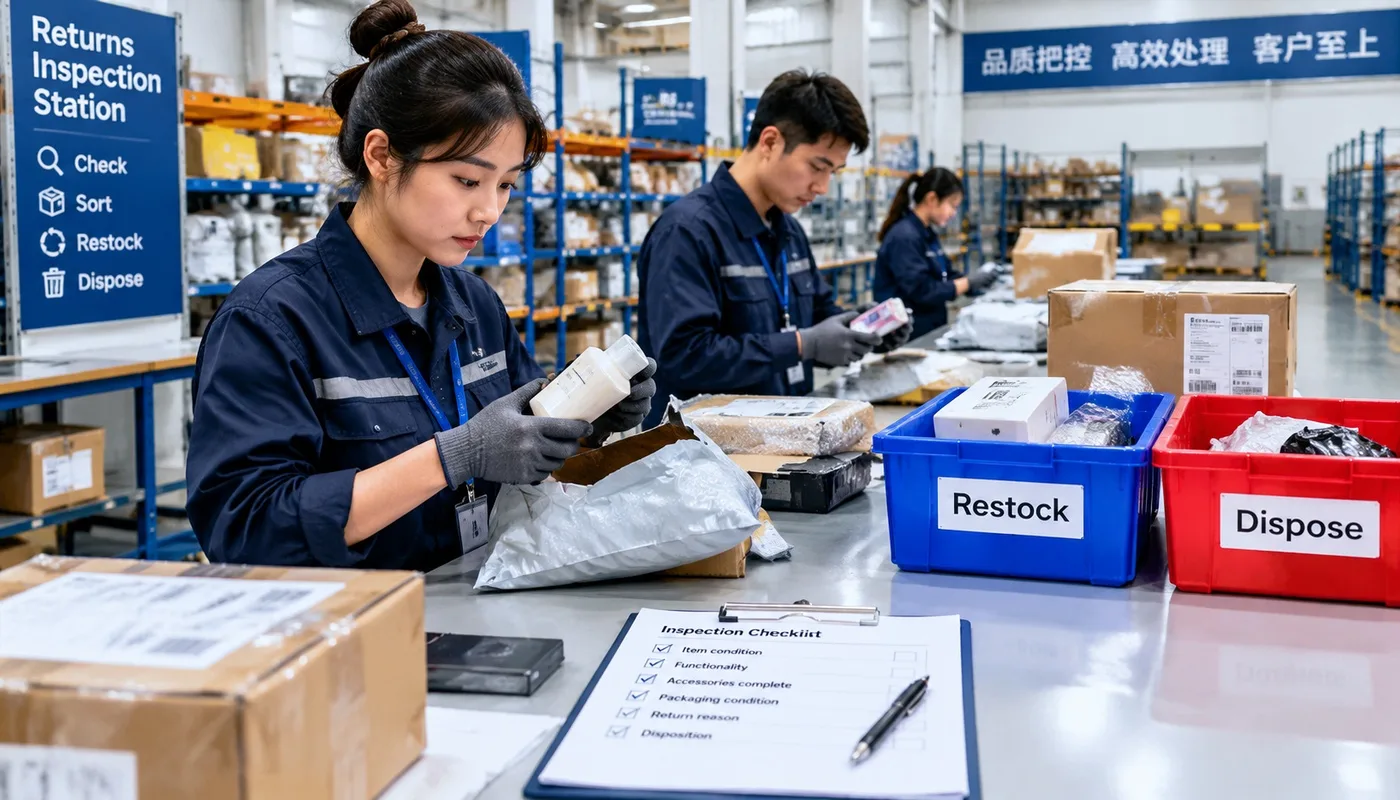
Returns are the most under-planned part of cross-border dropshipping from China. Most sellers design their fulfillment workflow around the outbound shipment — pick, pack, dispatch, track, deliver — and treat returns as an afterthought. But for small-parcel direct shipping to the US, EU, and UK, the returns workflow directly affects buyer trust, platform standing, and operating cost. A seller who cannot process a return within a reasonable timeframe faces chargebacks, negative reviews, and in some cases platform account restrictions.
FulfillNexa by SBT handles returns at its 8,000 m² Dongguan fulfillment center as part of its ecommerce single-order fulfillment workflow. Returned parcels are received, inspected, and dispositioned — restocked, refurbished, redirected, or disposed — according to the seller's agreed rules. This guide covers the practical decisions that determine how a returns workflow operates, what it costs, and which model fits different product profiles.
Three return routing models: which one fits
| Model | How it works | Cost per return | Transit time | Best fit |
|---|---|---|---|---|
| Cross-border return to China | Buyer ships back to the China fulfillment center | $5–$20+ (international return postage) | 10–25 days | High-value items where the product value exceeds return shipping cost |
| Local disposal or donation | Seller authorizes buyer to keep, donate, or dispose of the item | $0–$5 (refund only) | 0 days | Low-value items where return shipping exceeds product value |
| Destination-based return partner | Returns go to a local address in the buyer's country; consolidated and shipped back periodically | $2–$8 per return + consolidation fee | 3–7 days local + 15–30 days consolidation | Mid-value items with moderate return rates; multi-seller consolidation |
Most operators use a combination. The decision for each return should be: does the product value justify the return shipping cost? If a $3 phone case costs $8 to return, the rational decision is a refund without return. If a $150 electronic device costs $12 to return, the cross-border return is justified.
Return routing decision matrix
| Product value (landed) | Return rate | Recommended model | Rationale |
|---|---|---|---|
| Under $10 | Any | Local disposal / refund without return | Return shipping exceeds product value |
| $10–$30 | Under 5% | Cross-border return if resalable; otherwise refund | Evaluate per case |
| $10–$30 | Over 10% | Destination-based return partner | Volume justifies consolidation; reduces per-unit return cost |
| $30–$100 | Any | Cross-border return to China | Product value justifies return shipping |
| Over $100 | Any | Cross-border return with insurance | High value; insure the return shipment |
Designing the returns policy before launch
The returns policy should be published on the store and communicated to the buyer before purchase, not improvised after a complaint. Key elements:
| Policy element | What to decide | Platform requirement |
|---|---|---|
| Return window | How many days after delivery? | EU: minimum 14 days (consumer right of withdrawal). US: no legal minimum, but Amazon expects 30 days. |
| Who pays return shipping? | Seller, buyer, or conditional? | Amazon: seller pays if defect; buyer pays if preference. EU: seller pays if within withdrawal period. |
| Condition requirement | Original packaging? Used? Damaged? | Define acceptable return condition and communicate it. |
| Refund method | Original payment method? Store credit? | Platform rules may require original payment method. |
| Refund timing | When is the refund issued? | Upon receipt and inspection? Upon carrier scan of return? |
The DDP vs DAP customs guide covers the customs implications of returned goods, including whether duties can be reclaimed on re-import.
The returns workflow: step by step
- Buyer initiates return. Through the store platform, buyer submits a return request with reason and photos if applicable.
- Seller reviews and authorizes. Based on the reason, value, and policy: authorize cross-border return, authorize refund without return, or reject with explanation.
- Return label issued (if authorized). Seller provides a return shipping label or return authorization with the China warehouse address.
- Buyer ships return. Tracking number uploaded. Seller monitors for carrier acceptance.
- Parcel received at China fulfillment center. Warehouse logs receipt, checks against the return authorization, and begins inspection.
- Inspection. Determine disposition: restock (item resalable), refurbish (minor repair needed), redirect (ship to a different buyer), or dispose (damaged beyond recovery).
- Refund issued. Based on the agreed trigger: upon carrier scan of return, or upon receipt and inspection at the warehouse.
- Record and analyze. Log the return reason, product, and disposition. Use this data to identify patterns — defective batches, misleading descriptions, or packaging failures.
Platform-specific return requirements
| Platform | Return window (standard) | Who decides return shipping cost? | Key constraint |
|---|---|---|---|
| Amazon FBM | 30 days from delivery | Seller's policy, but A-to-Z Guarantee overrides | Late response to return request triggers A-to-Z claim |
| Shopify | Merchant-defined | Merchant-defined | No platform constraint; chargeback risk if policy is unreasonable |
| eBay | Seller-defined (must meet minimum) | Seller-defined; eBay Money Back Guarantee overrides | Defect rate increases if returns are mishandled |
| TikTok Shop | Platform-facilitated | Platform rules apply | Strict response time SLAs; shop penalties for non-compliance |
Cost of returns: what to budget
| Cost component | Cross-border return | Local disposal | Destination partner |
|---|---|---|---|
| Return postage | $5–$20+ | $0 | $2–$5 (local) |
| Customs on re-import | May apply (duty drawback possible) | N/A | Consolidated shipment customs |
| Inspection labor | $0.30–$0.80 per unit | N/A | $0.30–$0.80 per unit |
| Restocking | $0.20–$0.50 per unit | N/A | $0.20–$0.50 per unit |
| Disposal | $0.10–$0.30 per unit | $0 (buyer keeps) | $0.10–$0.30 per unit |
| Refund to buyer | Product price + original shipping | Product price + original shipping | Product price + original shipping |
For a typical small-parcel dropshipping operation, returns cost 3–8% of gross revenue when managed with a clear policy and routing rules. Without a policy, the cost can reach 10–15% due to chargebacks, platform penalties, and ad-hoc decision-making.
What to send for a returns workflow design
Provide the following to scope a returns workflow:
- Product catalog with landed cost per item
- Current return rate (if available) by product or category
- Sales channels and their return policy requirements
- Destination countries and buyer profile
- Current returns handling method (if any)
- Whether a destination-based return partner is acceptable
With this data, a fulfillment team can recommend the appropriate routing model, define the inspection and disposition rules, and build the workflow into the existing fulfillment operation. See the small parcel direct shipping cost guide for the outbound cost context and the multichannel integration guide for channel-specific return requirements.
FAQ
How do returns work for dropshipping from China?
The buyer ships the returned item back to the China fulfillment center (or to a local return partner in the destination country). The fulfillment center inspects the item and determines disposition — restock, refurbish, redirect, or dispose. The seller then issues a refund based on the published returns policy.
Is it worth paying for cross-border return shipping on every item?
No. For low-value items (under $10), the return shipping cost typically exceeds the product value. A refund without return is more economical. For high-value items (over $30), cross-border return is usually justified. The decision should be made per product, not as a blanket policy.
What are the customs implications of returning goods to China?
Returned goods re-entering China may be subject to customs procedures. In some cases, duty drawback is available if the goods are re-imported within a specified period and in their original condition. The specific treatment depends on the origin country, the destination country the goods were returned from, and the current customs regulations. Consult a qualified customs advisor for the actual shipment.
How do EU and UK consumer return rights affect China-origin sellers?
EU consumers have a 14-day right of withdrawal for distance purchases. UK consumers have similar rights under the Consumer Contracts Regulations. These rights apply regardless of where the seller is based. A China-origin seller must honor these rights and provide a functional returns process.
Can FulfillNexa handle returns for orders shipped from its warehouse?
Yes. Returns are processed at the Dongguan fulfillment center as part of the ecommerce fulfillment workflow. The inspection, disposition, and restocking steps are integrated into the same operating system that manages outbound orders. See the dropshipping from China to US & EU guide for the complete fulfillment workflow.
Sources and verification links
Operational rules can change. Check the linked primary sources and confirm shipment-specific requirements before booking.
- CBP import returns guidanceOfficial source
- European Commission consumer right of withdrawalOfficial source
- UK Consumer Contracts RegulationsOfficial source