
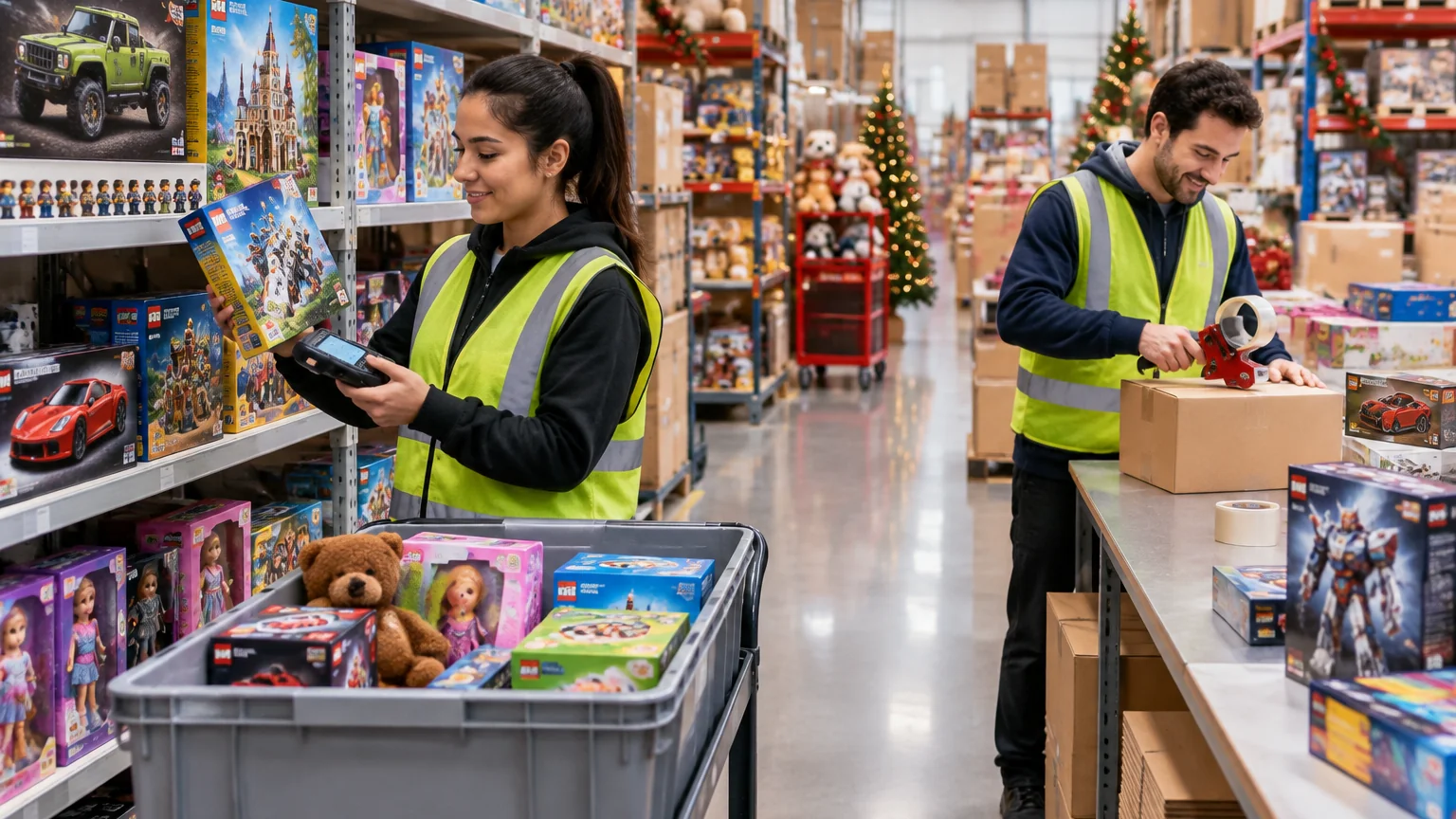
Toy and hobby fulfillment needs two parallel approvals: whether the product can legally be sold in its destination market, and whether the physical order is complete and ready to ship. A warehouse inspection does not replace safety testing, certification or the importer's responsibilities.
FulfillNexa's Dongguan warehouse provides 8,000 m² focused on ecommerce warehousing and one-piece fulfillment, including toys. The agreed work order should define product acceptance, document checks, kit handling and exceptions. Do not infer universal toy or battery acceptance from the category name.
Classify the actual product and intended user
A children's toy, an adult collectible and an electronic hobby kit may have different requirements. Age labeling alone does not determine classification; the responsible business should review the product's design, intended use and applicable market rules.
For US toys, CPSC guidance explains applicable ASTM F963 requirements and children's-product obligations. Covered products intended primarily for children 12 or younger generally need the relevant testing and a Children's Product Certificate. Not every hobby item has the same certificate requirements.
Include current import certificate handling
CPSC's eFiling guidance sets a July 8, 2026 implementation date for most covered imported consumer products, with a later date for specified foreign-trade-zone entries. Determine whether the actual product and entry are covered and who supplies the certificate data.
Ask the importer and broker to confirm the filing process before booking. A PDF stored in a warehouse folder does not by itself establish that required entry data has been filed.
For Great Britain, official toy guidance recognizes relevant CE-marked products as well as the UKCA route under the stated rules. Do not tell sellers that UKCA is the only possible marking. Northern Ireland and EU sales require their own applicable assessment.
Keep an approved product file
| Record | Operational use |
|---|---|
| SKU, model and intended age group | Prevent product substitution |
| Approved labels and instructions | Check the correct market version |
| Applicable testing and certificate references | Support the responsible party's review |
| Batch or production reference | Trace a complaint or recall |
| Kit component list | Verify completeness |
| Battery details, if present | Obtain transport acceptance review |
A component or factory change can require reassessment. Do not attach a test report for one model to every product in a similar-looking range.
Control kit assembly and picking
Define each sellable kit's component list and approved packing sample. Record whether small accessories are sealed inside the retail pack or added during fulfillment. A kit with a missing part should be held, not released under the complete-kit SKU.
Separate stock states for approved products, document holds, damaged goods and incomplete kits. Preserve lot identity where needed so a later issue can be traced without guessing which supplier batch served an order.
Screen batteries before choosing a lane
Electronic toys and hobby equipment need battery-specific review. Lithium-ion and lithium-metal entries differ, and standalone, packed-with and contained-in-equipment configurations are not interchangeable. Use the battery booking checklist and trained review; do not declare all non-lithium batteries unrestricted.
Plan seasonal volume and returns realistically
Use the merchant's forecast and actual order history. Agree capacity assumptions, replenishment dates and an overflow decision, without promising unlimited peak-season handling. A delayed supplier component can stop kit fulfillment even when other parts are available.
Return and recall handling should identify who authorizes a hold, customer communication and final disposition. Do not return a recalled or unresolved safety-related product to normal stock after a superficial visual check.
FAQ
Does every hobby item require a CPC?
No. The responsible party must determine product classification and applicable rules. Do not apply children's-toy requirements indiscriminately.
Does a warehouse check prove safety compliance?
No. It can verify agreed visible features and records, but cannot substitute for applicable testing or certification.
Is UKCA the only option for Great Britain toys?
No. Current official guidance also recognizes the relevant CE route under its conditions. Check the actual product and market.
Can battery-powered toys use the ordinary parcel lane?
Only after the battery configuration and the accepting service have been reviewed and approved.
Which records should travel with a production batch?
The age-grading basis, the test report or certificate reference for the specific product and factory, the tracking label artwork as applied, the assembly or component list for kits, and the supplier declaration behind any shared molding. Batch identity is what turns a single failure into a contained action instead of a catalog-wide recall.