
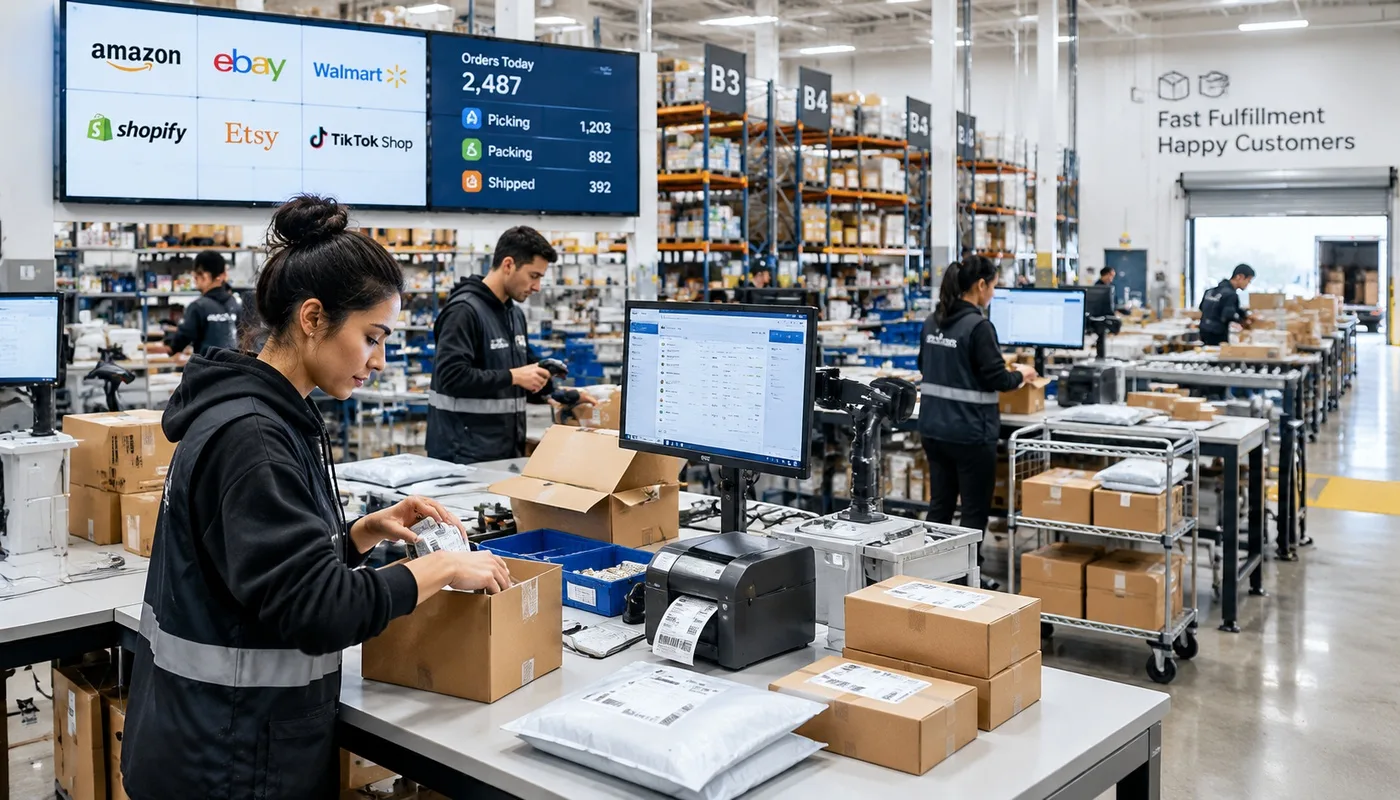
Running one-piece dropshipping from a single China fulfillment center across multiple sales channels — Shopify, TikTok Shop, eBay, Amazon FBM, and others — requires more than a connector login. Each channel has different order schemas, inventory sync rules, cancellation windows, returns workflows, and tracking upload requirements. A successful multichannel setup maps these differences before the first order ships, not after a mis-fulfilled batch triggers account warnings.
FulfillNexa by SBT coordinates this ecommerce workflow from its 8,000 m² Dongguan fulfillment center, which handles single-order pick, pack, and dispatch for cross-border parcels. Its 3,000 m² Shenzhen site supports oversized cargo and sea-air transshipment for lanes that need a different operating profile, and its 13,000 m² Suzhou site covers East China supplier consolidation. This guide focuses on the Dongguan ecommerce workflow — the one most relevant to multichannel dropshipping operators.
Channel comparison: what differs at the fulfillment layer
| Channel | Order sync method | Inventory sync | Tracking upload | Cancellation window | Returns handling | Key constraint |
|---|---|---|---|---|---|---|
| Shopify (store-owned) | API / webhook | Real-time via connector | Automatic on fulfillment | Until fulfillment status changes | Merchant-defined return policy | Full control; no platform restrictions on fulfillment origin |
| TikTok Shop | API / seller center | Platform-managed or manual | Must upload within required SLA | Varies by marketplace | Platform-facilitated returns | Strict late-shipment penalties; ship-from-country must match listing |
| eBay | API / seller hub | Manual or via listing tool | Upload tracking within required timeframe | Until shipped and scanned | Buyer-seller negotiated or eBay Money Back Guarantee | Item location must match listing; defect rate affects seller standing |
| Amazon FBM | SP-API / Seller Central | Seller-managed; Amazon does not sync inventory | Confirm shipment within 30 hours; upload valid tracking | Until buyer cancellation request | A-to-Z Guarantee; seller-managed returns | Late shipment rate must stay below 4%; valid tracking rate above 95% |
| WooCommerce | REST API / webhook | Plugin-based or custom | Automatic via fulfillment plugin | Until order status changes | Merchant-defined | More flexible than marketplace platforms; plugin quality varies |
The critical difference is not the connector — it is the penalty structure. Amazon penalizes late shipments and invalid tracking. TikTok Shop penalizes late dispatch. eBay penalizes item-location mismatches. Each platform has a different tolerance for fulfillment errors, and the China-origin fulfillment workflow must be designed around the strictest constraint, not the most lenient one.
Seven-step multichannel launch workflow
- Designate the master inventory system. Choose one system — the WMS, the store, or a middleware — as the single source of truth for stock levels. All other channels sync from this master.
- Map SKUs across channels. The same physical product may have different SKU formats on Shopify, Amazon, eBay, and TikTok Shop. Build a mapping table before connecting.
- Define the order routing rule. Decide whether all channels route to the same fulfillment queue, or whether specific channels or lanes get priority. Document the rule.
- Set the cancellation window per channel. Amazon may allow buyer cancellation within minutes. Shopify allows it until fulfillment. Configure each channel's cutoff before orders enter the pick queue.
- Test with a controlled pilot. Process 10–20 orders per channel through the full cycle: order receipt, pick, pack, label, tracking upload, and delivery confirmation. Verify each channel's requirements independently.
- Monitor channel-specific health metrics. Amazon: late shipment rate, valid tracking rate. TikTok Shop: on-time dispatch rate. eBay: defect rate. Track each separately.
- Build an exception playbook. Define who handles a rejected order, a missing scan, a customs query, or a return request — and within what timeframe — for each channel.
Inventory sync: the most common failure point
Inventory desynchronization is the single most frequent cause of multichannel fulfillment errors. The typical failure sequence:
- A product sells on Channel A.
- Inventory is not yet decremented on Channel B.
- The same unit sells on Channel B.
- The fulfillment center receives two orders for one physical unit.
Preventing this requires near-real-time sync with a confirmed write-back. The sequence should be: order received → stock reserved → stock level pushed to all channels → pick confirmed → shipment recorded. Any break in this chain creates oversell risk.
| Sync approach | Latency | Oversell risk | Complexity | Best fit |
|---|---|---|---|---|
| Webhook-based real-time | Seconds | Low | Medium | Shopify, WooCommerce |
| API polling (every 1–5 min) | 1–5 minutes | Moderate | Low | eBay, TikTok Shop |
| Manual stock update | Hours | High | None | Small catalogs, low volume |
| Middleware / OMS | Seconds to minutes | Low | Higher | Multiple channels, high SKU count |
For operators running 50+ SKUs across 3+ channels, a middleware or order management layer typically pays for itself within the first oversell incident. For operators with fewer SKUs and lower volume, direct API connections with aggressive polling intervals can be sufficient.
Tracking upload requirements by channel
| Channel | Upload deadline | Format | Consequence of failure |
|---|---|---|---|
| Amazon FBM | Within 30 hours of shipment confirmation | Valid tracking number from accepted carrier | Late shipment rate increases; potential account suspension above 4% |
| TikTok Shop | Within platform SLA (typically 2–3 business days) | Valid tracking with carrier scan | Late dispatch penalty; potential shop restriction |
| eBay | Within handling time stated in listing | Tracking number uploaded | Defect rate increase; search ranking impact |
| Shopify | No platform deadline (merchant sets promise) | Tracking number in order | Customer experience impact; chargeback risk if not communicated |
The tracking number alone is not sufficient. Amazon requires that the tracking number shows a carrier scan within a specific timeframe. A tracking number without a scan event does not count as "valid tracking" for Amazon's metrics. Plan the carrier handoff and first-scan timing accordingly.
Scaling from one channel to many
| Stage | Channels | Orders/month | Recommended setup |
|---|---|---|---|
| Single store | 1 (Shopify or own site) | 0–200 | Direct connector; manual stock updates acceptable |
| Dual channel | 2 (e.g., Shopify + Amazon) | 200–1,000 | API polling or middleware; SKU mapping table required |
| Multi-channel | 3–5 (Shopify + Amazon + eBay + TikTok + other) | 1,000–5,000 | Middleware or OMS; real-time sync; dedicated exception handler |
| High volume | 5+ channels | 5,000+ | Full OMS with automated routing, exception queues, and channel-specific SLA monitoring |
At each stage, the fulfillment operation does not change fundamentally — the same pick, pack, and dispatch workflow applies. What changes is the coordination layer between the sales channels and the warehouse. The dropshipping from China to US & EU guide covers the end-to-end workflow for a single-channel launch.
What to send for a multichannel integration review
Provide the following to scope a multichannel fulfillment setup:
- Current sales channels and store URLs
- Total SKU count and product categories
- Monthly order volume per channel
- Current inventory management method (spreadsheet, platform-native, OMS)
- Required delivery promises per channel and destination
- Returns policy per channel
- Any existing connector or middleware in use
With this information, a fulfillment team can assess the integration scope, recommend the sync architecture, and identify channel-specific constraints before the first order is routed.
FAQ
Can one China fulfillment center ship to orders from Shopify, Amazon, eBay, and TikTok Shop simultaneously?
Yes. The physical fulfillment workflow — pick, pack, label, dispatch — is the same regardless of the sales channel. The coordination layer (connector, middleware, or OMS) manages order routing, inventory sync, and tracking upload for each channel independently.
What is the most common cause of multichannel fulfillment errors?
Inventory desynchronization. When stock levels are not updated in near-real-time across channels, the same physical unit can be sold twice. A middleware or order management system with confirmed write-back significantly reduces oversell risk.
Does Amazon FBM from China work differently from FBA?
Yes. FBM (Fulfilled by Merchant) means the seller or their fulfillment partner handles pick, pack, and direct shipment to the buyer. FBA requires sending inventory to Amazon's warehouse first. Both can be operated from the same China fulfillment center, but the workflows, labeling, and compliance requirements are different. See the Amazon FBA prep SOP for FBA-specific requirements.
How strict are TikTok Shop's fulfillment requirements from China?
TikTok Shop requires tracking upload within the platform's specified SLA and enforces late-dispatch penalties. The ship-from country in the listing must match the actual fulfillment origin. Confirm the current TikTok Shop seller policies for the specific marketplace before launching.
What happens when an order needs to be canceled after it has been picked?
Define a cancellation cutoff per channel before orders enter the pick queue. Once a parcel is manifest-closed and handed to the carrier, cancellation becomes a return or refusal workflow, which is more costly and slower. The earlier the cutoff is enforced, the lower the exception cost.
来源与核验链接
操作规则可能变更。请查阅链接的原始来源,并在订舱前确认具体货件要求。