
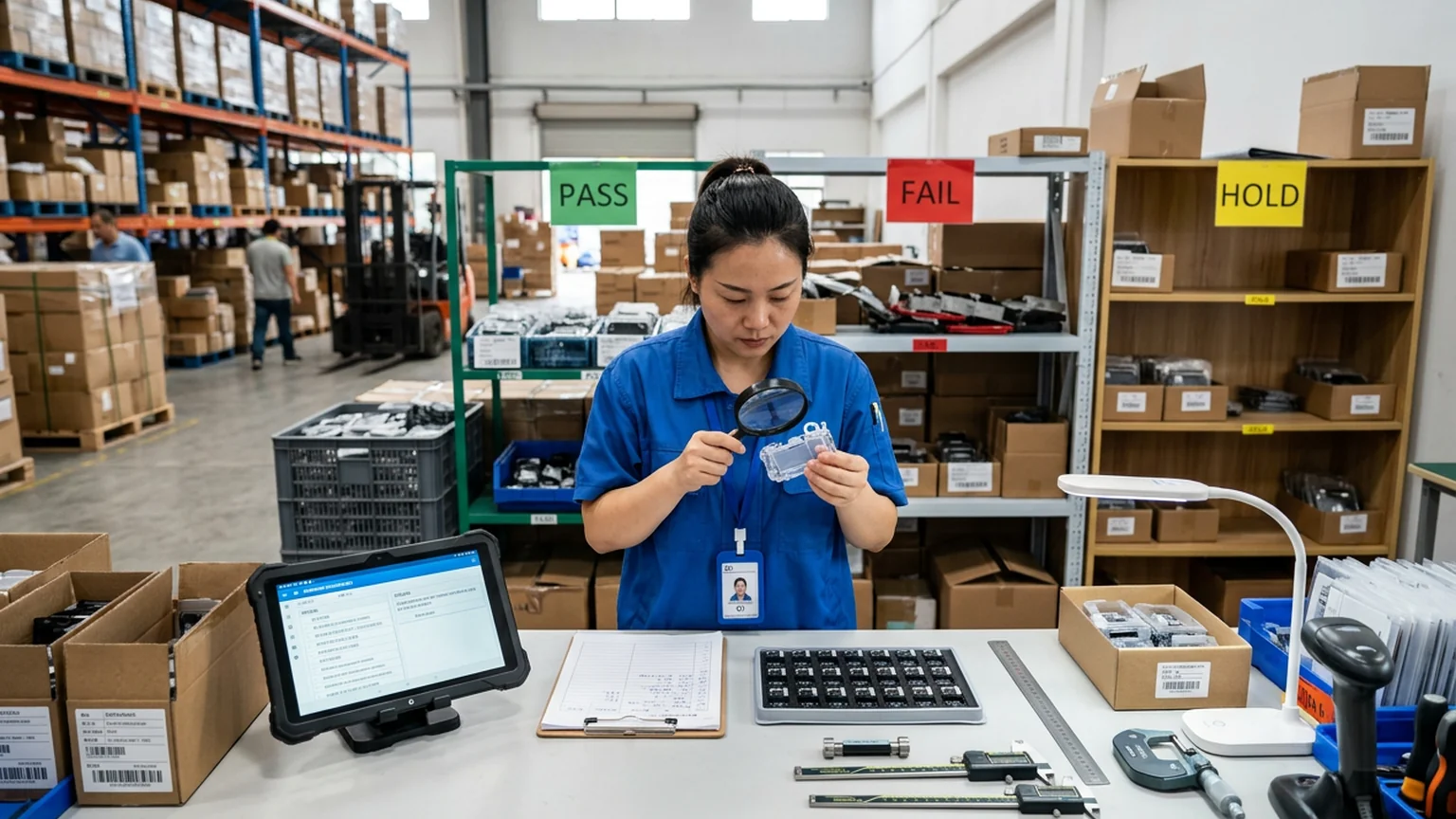
Quality inspection is the cheapest point in the supply chain at which a defect can be caught. After a container is on the water, the same defect costs freight, duty, storage, a replacement shipment, refund handling and reviews. The reason sellers still get this wrong is that they treat inspection as an event rather than as a written agreement with defined acceptance rules.
The four inspection moments, and what each one is for
Pre-production. Checking materials, components and the first article against the approved specification before the line starts. Short, and the only point at which a wrong component is cheap.
During production. Roughly forty to sixty percent through the run, when enough units exist to be representative and enough remain to be fixed at the factory's cost. This is where a systematic problem is still recoverable.
Pre-shipment. The classic inspection, performed when production is complete and packing is at least around eighty percent done, so that finished cartons and packing materials can be assessed. This is the gate before payment release and before freight.
Container loading supervision. Witnessing the count, the sealing, the stuffing method and the condition of the container. It does not retest the product, and it is what protects you against short shipment, mixed cartons and a load that shifts at sea.
A single pre-shipment inspection is the common minimum and is not sufficient for a new supplier, a new product, or anything with a safety dimension.
How sampling actually works
Sample-based inspection follows an acceptance plan, most often ISO 2859-1, which is technically identical to the widely referenced ANSI/ASQ Z1.4. The mechanic is a lot-based sampling plan: from a lot size and an inspection level, you get a sample size; from the sample size and an acceptable quality limit, you get an accept number and a reject number. Find more defects than the accept number and the lot is rejected as a whole, not partially.
Several details get consistently misunderstood.
The general inspection level is a starting convention, not a law. Level II is the usual default; tightened and reduced inspection levels exist and shift automatically with the supplier's history under the plan's own switching rules.
Acceptable quality limits are a business decision, expressed as defect counts per hundred units, and are normally set separately for critical, major and minor defect classes. Common consumer-goods settings sit in the region of zero for critical defects and a few percent for major and minor, but the right number depends on the product, the price point and who absorbs the cost. Copying an AQL from a blog post is how buyers end up accepting work they would reject in their own shop.
Sampling is probabilistic. A passed lot contains defects, and a rejected lot may contain fewer than a previous accepted one. The plan controls the risk of accepting bad lots across many submissions; it does not certify an individual carton.
Classify defects before you count them
The three classes are defined by consequence, and the definitions must be written for your specific product before the inspector arrives.
Critical. A hazard, a prohibited substance, a missing or false safety warning, a broken child-resistant closure, a choking hazard in a product not age-graded for it, counterfeit or wrong-regulation marking, a wrong declared voltage. Anything where shipping it is worse than not shipping it.
Major. Affects function, fit, safety performance or saleability in a way the customer will notice and return for. A zipper that fails, a seam that splits, a component that does not assemble, a color visibly off from the approved standard, packaging that cannot survive normal handling.
Minor. A cosmetic deviation that most customers tolerate and that does not affect function or compliance. A thread, a small mark, a slight print offset.
Without written definitions and a photographed boundary sample for each class, two competent inspectors will classify the same unit differently, and the supplier will argue about every borderline case.
| Inspection element | What is actually checked | Common failure of the process |
|---|---|---|
| Specification match | Approved sample, artwork, bill of materials, color standard | Inspected against a description instead of a signed sample |
| Workmanship | Class-based defect counting against written criteria | Defect classes not defined before counting |
| Function | Power-on, charge, fit, assembly, cycles, sealed units | Visual-only inspection of a functional product |
| Measurement | Key dimensions, weight, thickness, tolerance stack | Only one unit measured instead of a sample |
| Safety and marking | Required labels, warnings, certificates, age grading | Marks verified on paperwork but not on the unit |
| Packaging | Carton strength, marking, barcodes, barcode scan test | Barcode never physically scanned |
| Drop test | ISTA-style sequence on packed cartons | Only the supplier's sample tested |
| Loading | Count, seal number, dunnage, photographs, condition | Loading witnessed by no one |
Evidence, not opinion
An inspection report that is worth anything contains: the sampling plan used with its AQL and levels, the lot size and sample size, the defect list with photographs per finding and per class, the measurements taken with actual values, the on-site tests performed with results, the packaging and carton markings photographed, the seal number if loading was supervised, and a clear pass, fail or pending disposition with the reason.
Ask for the photographs of every individual defect, not a summary count. That is the difference between a report you can act on and a document that says an inspector was cheerful.
What inspection cannot do
It cannot fix a supplier with no capability, only grade it. It cannot detect a latent defect that appears after weeks of use. It cannot test every unit, and it does not cover a defect introduced in the last cartons packed after the inspector leaves, which is one reason container loading supervision exists. It cannot make a product compliant if the design or the claims are wrong. And a report from an inspection company is not a legal certification in any market.
The strongest preventive measure is not more inspection. It is an approved production sample, signed and retained by both parties, a written bill of materials, and a payment term that releases the balance against a passed inspection.
Building it into the fulfillment path
Sellers who consolidate multiple factories before export have an extra advantage here: the shipment can be held, opened, inspected and re-stuffed at one location instead of negotiating a visit to three provinces. Inbound QC at a consolidation warehouse also catches the failure modes that individual factory inspections miss, especially short shipment, mixed cartons, wrong packing list, substituted cartons and damaged goods that were fine when the inspector left.
If you run both a factory inspection and a warehouse inbound check, write down which one is the release gate. Two teams each assuming the other blocked the bad lot is a real and expensive arrangement. The receiving and staging workflow is described in our supplier consolidation guide.
Frequently asked questions
What AQL should I use?
Zero for critical defects, and a major and minor limit set from your own cost tolerance rather than a copied figure. AQL is a business decision expressed in defects per hundred units, and the same number can be reasonable for a budget item and unacceptable for a premium one.
How large a sample will be inspected?
Determined by the sampling plan from lot size and inspection level, not by negotiation. Under ISO 2859-1 general inspection level II you get a defined sample size with an accept and reject number; a lot exceeding the accept number is rejected as a lot.
Is one pre-shipment inspection enough?
For a mature, proven supplier on an unchanged product, often yes. For a new supplier, a new tooling run, or a product with safety or compliance exposure, add a during-production check and container loading supervision.
Can inspection catch every defect?
No. Sampling accepts a statistical amount of defectives by design, latent failures appear later, and the plan's switching rules only work across many submissions. The goal is to move the catch point earlier and cheaper, not to reach zero.
What should I do when a lot fails?
Three options, in escalating cost order: 100 percent sorting at the supplier's expense with a re-inspection, rework of the specific defect class, or rejection and re-production. Whichever you choose, record it, and make it a term of the purchase order before the next order rather than an argument afterwards.
来源与核验链接
操作规则可能变更。请查阅链接的原始来源,并在订舱前确认具体货件要求。