
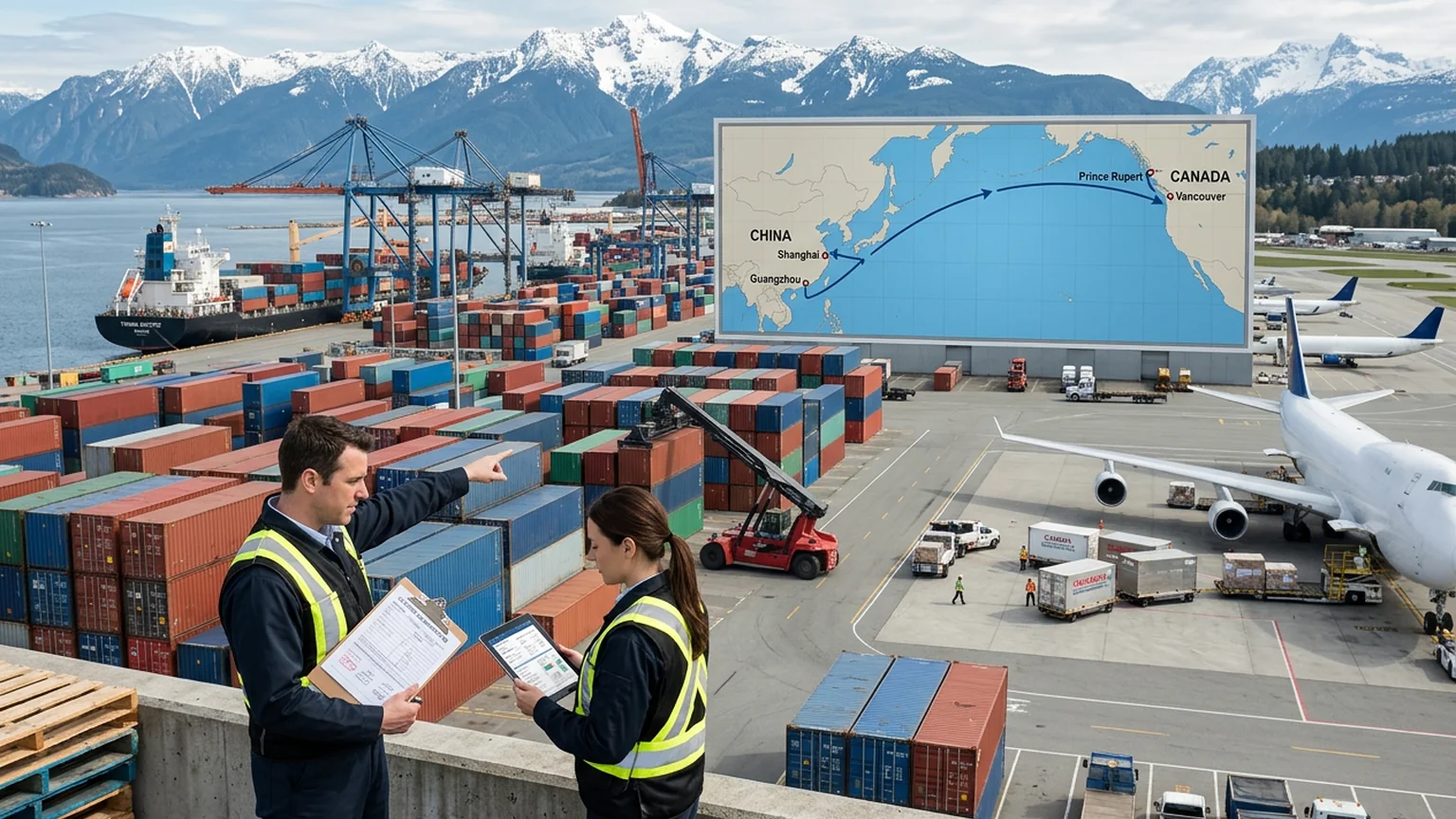
Canada is a small-share market for most China-origin sellers and a disproportionately loud one when something goes wrong. Volumes are lower than the United States, delivery distances are longer, and the border is run by an agency that expects complete data on every shipment regardless of value. Customers are also quick to escalate a surprise fee, because the alternative to paying it is refusing the parcel.
The practical answer is to treat Canada as its own lane with its own document set, its own tax logic and its own final-mile reality, rather than as an extension of a US workflow.
What CBSA expects on a commercial parcel
The Canada Border Services Agency assesses imports on declaration data: a proper description of the goods, the correct HS classification, the value in the declared currency, the country of origin, and the identity of the party accountable for the entry. Postal and courier traffic moves through simplified processes, but simplified does not mean undocumented. Descriptions copied from a storefront title are the most common cause of a parcel being held, examined or referred for a formal entry.
Two fields decide most Canadian outcomes. Classification sets the duty rate and whether the goods fall under a special program. Origin determines both the duty treatment and the marking requirement. China-origin goods do not receive the preferential rates available to CUSMA partners, so a rate that a US-based colleague quotes is not automatically the Canadian rate for the same item.
Importers who sell into Canada at volume should decide early whether they will register as a non-resident importer, let the carrier act as broker on each shipment, or work with a Canadian customs broker. Each option changes who signs the entry, who can recover input tax, and how a correction gets made after the fact.
Duty and tax thresholds are not one number
Canada applies duty and taxes against separate value thresholds, and the courier rules differ from the postal rules. The figures commonly cited for courier imports are a duty-free level around CAD 20 and a tax-free level around CAD 40, with duties engaging at higher values. Those numbers have changed before and will change again, so verify them on the CBSA site before you set prices or write checkout copy, and check the date on any third-party summary you find.
Above those thresholds the tax stack is where sellers get surprised. Federal GST is 5 percent. Participating provinces harmonize it into an HST at higher combined rates, while other provinces apply a separate provincial sales or retail tax, and Quebec charges its own provincial tax on top. The rate a customer pays therefore depends on the destination province, not the origin of the goods.
| Canada decision | What determines it | Where sellers lose money |
|---|---|---|
| Duty rate | HS classification and country of origin | Assuming a US duty outcome applies in Canada |
| Federal and provincial tax | Destination province and the value thresholds in force | Quoting one flat tax assumption nationally |
| Who pays at delivery | Whether tax was collected at checkout and declared correctly | Leaving collection to the carrier, which adds a handling fee |
| Entry route | Shipment value, frequency and commodity | Building a lane around a low-value shortcut with no fallback |
| Marking and labeling | Federal consumer product rules plus Quebec language requirements | English-only labels and missing fibre-content or origin marks |
| Returns | Cost of re-export versus local disposition | Paying to ship a low-value item back to China |
Labeling and regulated categories
Canada's consumer product regime is stricter on paper than many sellers expect. The Canada Consumer Product Safety Act imposes general safety duties, and toys intended for children under fourteen carry specific restrictions on substances and mechanical hazards. Consumer chemicals and containers sold to households carry bilingual labeling and, where relevant, precautionary symbol requirements. Textiles need fibre-content and origin marking under the Textile Labeling Act. Electronics and anything with a radio transmit under Innovation, Science and Economic Development requirements and need an IC identifier where applicable. Natural health products, cosmetics and over-the-counter drugs sit with Health Canada and carry license or notification numbers that appear on the label. Food falls to the Canadian Food Inspection Agency.
A fulfillment warehouse does not make a product compliant. Its useful job is to catch the mismatch before the parcel is tendered: check that the marks and numbers the destination expects are physically present and legible, hold what fails, and escalate.
Final-mile geography
Canada's population is concentrated, but the addresses are not. Urban Ontario, Quebec, Alberta and the Lower Mainland behave like any developed market. Remote and northern communities behave differently: longer transit, limited carrier options, and surcharges that can exceed the item's value. Before promising coverage, compare lanes on hand-off partner, tracking depth, residential and remote-area surcharges, and whether the parcel is delivered to a door or held at a local pickup point.
A pattern worth knowing: a lane priced attractively for Toronto and Vancouver can be the most expensive option for a Saskatchewan town or a Maritime rural route, because the hand-off partner differs. Ask which carrier physically completes each delivery and what that carrier charges for the exceptions.
Returns without an import nightmare
Shipping a returned Canadian parcel back to China usually costs more than the item is worth, and re-importing it into China raises its own documentation questions. Most sellers handle Canada with a local disposition path instead: a domestic return address, an inspection rule written per SKU, and a threshold under which the item is donated, liquidated or destroyed rather than shipped. Higher-value units can be inspected locally, consolidated, and returned to China in one commercial shipment where the economics justify it.
Whatever the shape, write the rule down before the first return arrives, so the warehouse is executing an agreed decision rather than inventing one. The wider reverse-logistics trade-offs are set out in our cross-border returns playbook.
Frequently asked questions
Does China-origin cargo get preferential duty in Canada?
No. Preferential rates under CUSMA depend on qualifying North American content. Ordinary China-origin goods are assessed at Canada's most-favored-nation rate for the classification, so confirm the rate against the HS code rather than borrowing a US outcome.
What are Canada's low-value thresholds?
Duty and taxes are assessed against separate thresholds on courier and postal imports, commonly cited around CAD 20 and CAD 40, with duties engaging at higher values. These figures change, so confirm current amounts on the CBSA site before pricing or writing checkout copy.
Is 5 percent GST the whole tax bill?
No. Federal GST is 5 percent, but participating provinces apply a harmonized sales tax at higher combined rates, some provinces add a separate sales or retail tax, and Quebec charges its own provincial tax. The destination province decides the outcome.
Which carrier delivers Canadian ecommerce parcels?
Hand-off partners commonly include Canada Post plus parcel networks such as Intelcom and GLP, alongside couriers such as Purolator, UPS and FedEx Canada. Compare lanes by hand-off partner, tracking depth, and remote-area surcharges rather than by headline price.
Should Canadian returns come back to China?
Usually not for low-value items, because return freight and re-import paperwork exceed the recovery. A Canadian return address with per-SKU inspection rules and a disposal threshold is normally cheaper; consolidate genuinely valuable units into one commercial shipment instead.
Fuentes y enlaces de verificación
Las reglas operativas pueden cambiar. Consulte las fuentes primarias enlazadas y confirme los requisitos específicos del envío antes de reservar.
- CBSA — ImportingFuente oficial
- Canada duties calculatorFuente oficial
- U.S. Customs and Border Protection — Country-of-origin markingFuente oficial
- International Trade Administration — Shipping and logisticsFuente oficial