
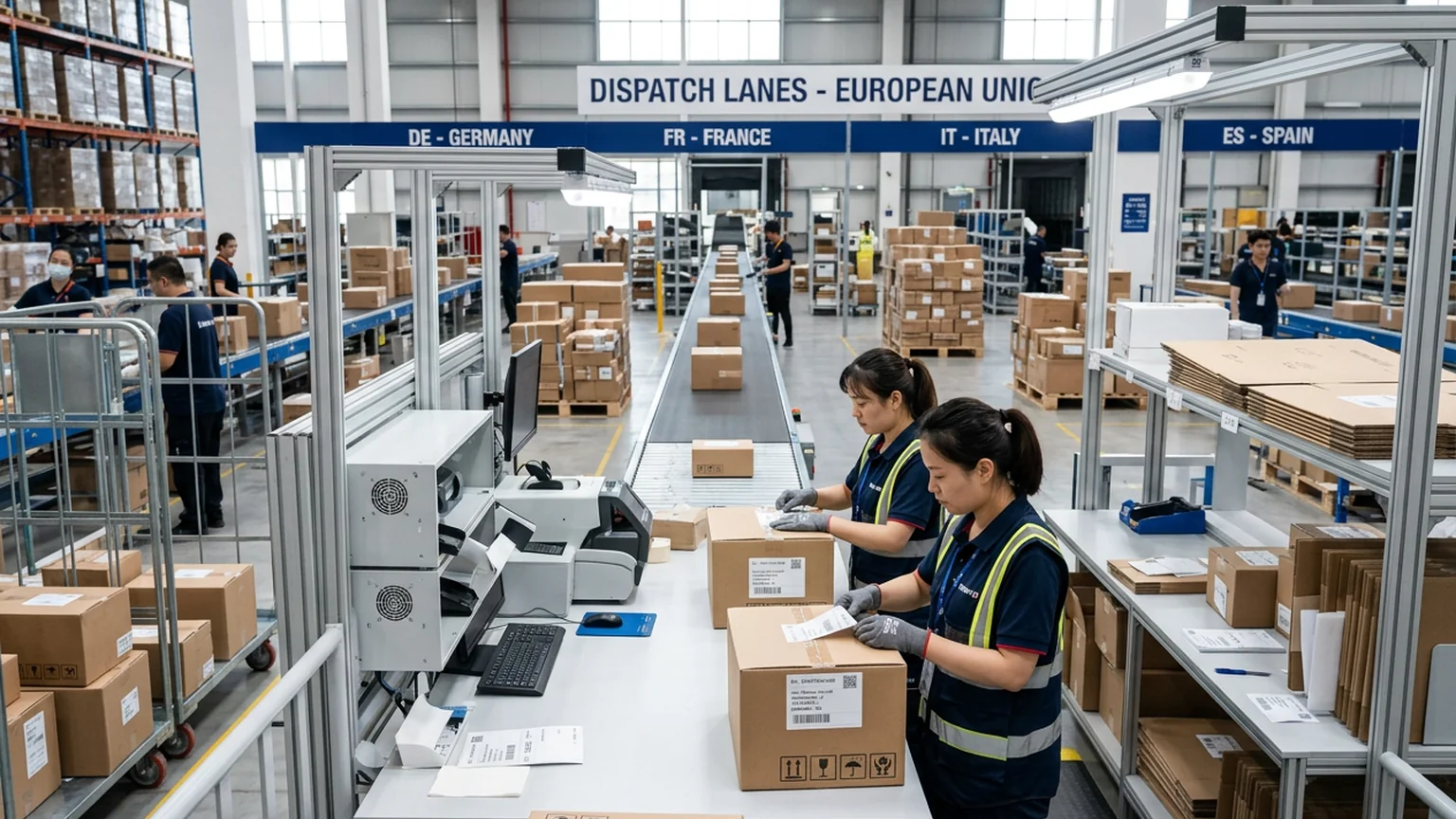
Germany is the destination most China-origin sellers get right on price and wrong on paperwork. The freight is easy to buy. The tax treatment, the registers you must appear in before you are allowed to place packaging or electronics on the German market, and the last-mile carrier choice are where margin quietly disappears.
The other reason Germany needs its own page: the rules that governed low-value parcels into the European Union changed in 2026. Advice written against the old regime still circulates everywhere, including in carrier brochures and third-party blogs. Start from what applies now.
The tax picture, as it stands in 2026
VAT on commercial imports has no de minimis in the EU. The old relief that exempted consignments of small value was removed in July 2021, so German import VAT is due on the goods regardless of value. What a seller then does about it is a collection question, not an exemption question.
IOSS, the Import One Stop Shop, is the simplification most distance sellers use. It lets VAT be collected at checkout and declared through a single return rather than paid and reclaimed on each parcel at the border. It applies to consignments with an intrinsic value of up to EUR 150 and it does not cover excise goods. A non-EU business cannot register directly; it uses an EU-established intermediary, which is a real cost and a real dependency worth pricing in.
IOSS is a VAT mechanism. It never covered customs duty, and this is the part that changed. The EU's EUR 150 customs-duty relief for low-value consignments ended on 30 June 2026. From 1 July 2026 an interim measure applies to covered small parcels until 1 July 2028: a fixed EUR 3 customs duty per different tariff subheading in the consignment. Three distinct articles in one box can therefore attract more than one charge. The legal basis and the transition detail are set out in our EU IOSS and customs duty guide for 2026.
Treat every number above as something to re-verify against the European Commission and your customs agent before you reprice a catalog or write checkout copy. These are exactly the thresholds that get revised.
| Germany and EU decision | What drives it | Typical costly mistake |
|---|---|---|
| VAT collection route | Consignment value, IOSS registration, excise status | Assuming IOSS also clears duty |
| Customs duty | Tariff classification and the 2026 small-parcel rules | Pricing on a pre-2026 duty-free assumption |
| Buyer charged on delivery | Whether VAT and duty were collected and declared at origin | Surprise fees, refused parcels, negative reviews |
| German market access | Packaging, electrical and battery registers | Shipping before registration is complete |
| Last-mile carrier | Parcel size, address density, pickup-point demand | One carrier for a 30 g sachet and a 40 kg planter |
| Returns handling | Cost of re-export versus local disposition | Paying EU return freight for a low-value item |
Germany's registers are a gate, not a formality
Germany enforces extended producer responsibility through named registers, and marketplaces are obliged to check them. The three that catch sellers out:
The packaging register under the Verpackungsgesetz. If you are the first business to place packaged goods on the German market, that is you, and it includes a distance seller shipping to private households. System participation and a registration number are required before selling. Marketplaces delist on missing LUCID numbers.
The electrical and electronic equipment register under the ElektroG. Goods with a plug or a battery generally fall in scope, which covers an enormous range of home, garden, kitchen and toy products. Registration needs an authorized representative established in Germany.
The battery register under the BattG for batteries and accumulators placed on the market, including those built into products.
There is also the classic EU conformity layer: CE marking where a directive or regulation applies, a Declaration of Conformity that names the applicable legislation, and importer and manufacturer identification on the product or its documentation. German-language instructions and safety information are expected for consumer goods. None of this is created by a warehouse. A fulfillment center's useful role is to refuse to tender parcels whose marks, numbers and labels are missing or illegible, and to escalate rather than ship.
Clearance and the data behind it
Commercial parcels into Germany move through the Import Control System, which expects entry data before arrival. HS classification, country of origin, value, and a description specific enough for an officer to assess risk decide whether a parcel flows or stops. Storefront titles copied into a commercial invoice are the single most common reason a shipment gets examined, and examination costs are billed to the importer of record.
Who that importer is needs to be a deliberate choice. Carrier-brokered entries with the carrier as importer suit low volume and create a hard ceiling. A German or EU importer of record, a fiscal representative where relevant, and an io-number for VAT reverse charges on commercial imports are the building blocks for anything at scale.
Choosing the German last mile
Germany has strong parcel infrastructure and a heavy pickup-point culture, which changes what "delivered" means. Compare lanes on: size and weight bands, whether the network covers business-only or residential addresses reliably, pickup-point and parcel-terminal coverage, return label mechanics, and the surcharge schedule for remote areas and islands, where Germany's own territory has some. Also check tracking depth into local languages, because your customers read the tracking page, not your dashboard.
A practical pattern: small light parcels to German households generally do best on a dedicated parcel network; bulky garden goods and multi-piece orders belong on a pallet freight product with a delivery window; and postal hand-off lanes that price well can underperform on proof-of-delivery quality.
Returns
German consumer law gives buyers a fourteen-day withdrawal right on distance contracts, and the refund duties that follow are unforgiving about who pays return freight when the seller has not told the consumer otherwise. Build the returns decision per SKU before launch: local inspection and restock, local resale or liquidation, or consolidation back to China only where the recovered value justifies the freight and re-import documentation. The wider trade-offs are in our cross-border returns playbook.
Frequently asked questions
Is there a low-value duty-free threshold for the EU now?
Not for the kind of parcel most dropshipping and DTC sellers ship. The EUR 150 customs-duty relief ended on 30 June 2026, and an interim EUR 3 duty per different tariff subheading applies to covered consignments until 1 July 2028. VAT never had a de minimis after July 2021. Verify current rules before pricing.
Does IOSS pay the customs duty?
No. IOSS is a VAT reporting mechanism for distance-sale consignments up to EUR 150 intrinsic value, excluding excise goods. Duty is a separate assessment, and since 1 July 2026 the interim flat-fee regime is what applies to covered small parcels.
Do I need a German registration to sell from China?
Usually yes, in more than one place: the packaging register, and the electrical or battery registers where your goods have a plug or a cell. Marketplaces verify these and delist on failure. Registration is a legal step for you, not a warehouse service.
Which carrier should I use for German parcels?
Choose by size band and address type rather than headline price. Dedicated parcel networks with pickup-point coverage suit small household goods; pallet products suit bulky garden items; postal hand-off lanes can be cheap and weak on delivery evidence. Ask which network physically completes the delivery.
What happens if the buyer is charged on delivery in Germany?
Refusals, disputes and reviews. The fix is upstream: collect VAT and duty correctly at checkout, declare the right values and classifications, and never let a low declared value pass as a cost saving. Understated values are a customs offense, not a lane option.
Fuentes y enlaces de verificación
Las reglas operativas pueden cambiar. Consulte las fuentes primarias enlazadas y confirme los requisitos específicos del envío antes de reservar.
- EU IOSS guideFuente oficial
- Germany VerpackGFuente oficial
- European Commission — Temporary flat fee on low-value importsFuente oficial
- EU Council — New customs duty rules for small parcelsFuente oficial